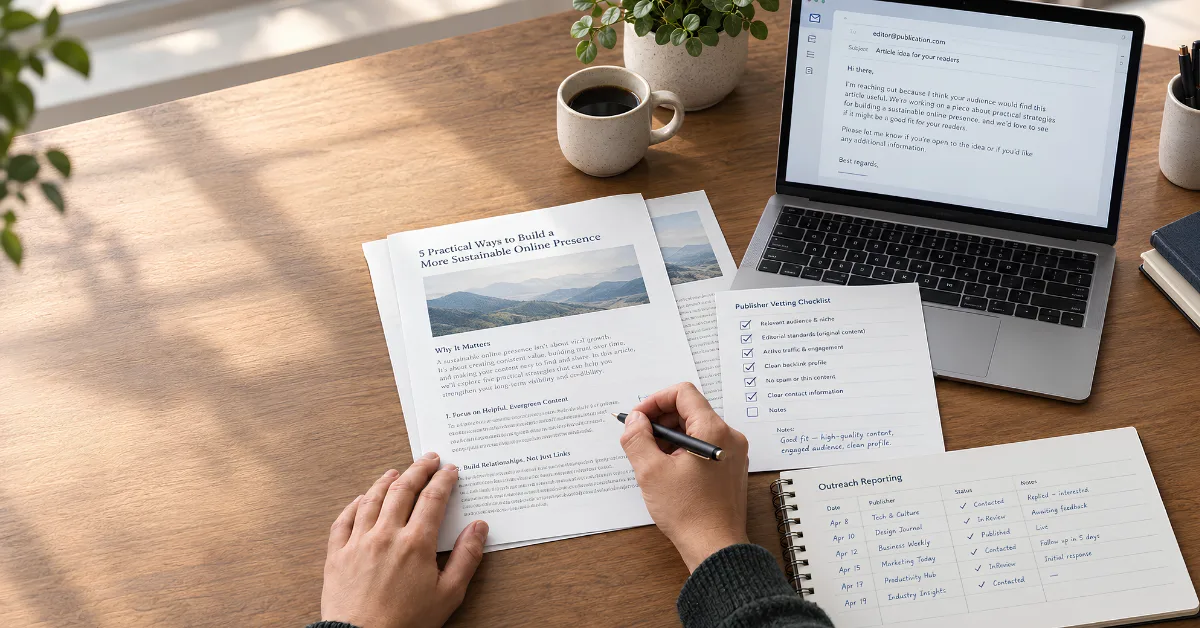
A backlink report may look impressive, yet tell you very little.
Twenty new links can come with a few attractive authority scores and green arrows.
But who reads those websites? Why have they linked to you? Would the links still make sense if Google disappeared tomorrow?
This is where a manual backlink service shows its value or its weaknesses. You are hiring more than someone to collect URLs; you are paying for research, good judgment, helpful content, and real conversations with publishers.
Here is how you can compare manual link building services without buying an expensive spreadsheet.
Table of Contents
1. Understand what a manual backlinks service actually does
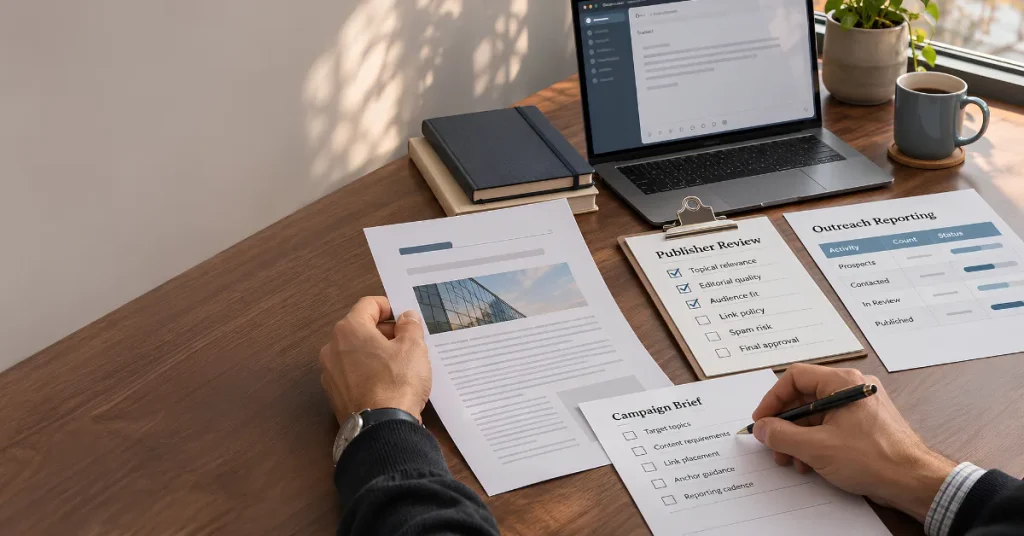
A manual backlinks service involves people identifying relevant websites, assessing publishers, contacting editors, and pursuing suitable linking opportunities in sequence: research, vetting, outreach, and acquisition. Page One Power clearly explains manual publisher outreach, while Sure Oak describes the process from prospecting to vetting, outreach, and link acquisition.
The main idea is that manual work relies on human decisions, not just avoiding software.
A team may use research tools, contact databases, and reporting software even if humans carry out the outreach. The key question is whether someone visits the website, understands who it targets, and decides whether the editor has a valid reason to care.
| Human-led outreach | Automated link creation |
| Evaluates individual publishers | Creates links through programmed actions |
| Pitches relevant resources or ideas | Often prioritizes repeatable placement volume |
| Leaves editorial decisions with publishers | May bypass meaningful editorial review |
| Reports placement context | May report little beyond link counts |
Google expressly includes automated services that create links as an example of link spam. Research and reporting tools do not constitute the same activity.
2. Look for a process that starts before the first email
I judge an agency based on the work it has done before I ask for a link.
An effective campaign brief should specify your business objectives, the priority pages, the audience, and the approval rules. Both Stellar SEO and OuterBox outline the sequence from target-page strategy to research before outreach.
A sensible workflow looks like this:
- Review the website and decide which content or technical issues to address first.
- Pick the pages you want to target and explain why these pages matter for your business.
- Look for research opportunities: relevant publications, how competitors cite them, resource pages, and references to the brand. Use that research to guide the next outreach step.
- Review the publishers before outreach. Make sure the audience matches, the content is of good quality, and there are no suspicious patterns.
- Suggest something useful. Provide some research, your expertise, a resource, or a good article idea.
- Check and report the placements after outreach. Verify the actual page, link, context, and status.
Imagine a small company that produces payroll software; a sensible group would promote its state-specific checklist in publications aimed at employers.
A team not targeting a specific audience could put it on a blog that covers payroll, patio furniture, and celebrity pets.
One option gives you a real audience, while the other offers available space.

3. Judge backlink quality beyond the headline score
A specialized manual backlinks service should explain why each publisher is included in your campaign.
Sure Oak explains how it assesses relevance at the website, page, and surrounding-text levels. At the same time, OuterBox likewise mentions the performance of manual checks regarding audience fit, traffic signals, editorial standards, and placement context.
Take the following as a buyer’s checklist, not as a Google scoring formula.
| Quality check | What to examine | Question to ask |
| Topic fit | Site, article, and linked page | “Why would this reader need our resource?” |
| Audience fit | Reader interests and geographic relevance | “Does this reach potential customers or credible industry peers?” |
| Editorial credibility | Authors, ownership, and consistent publishing | “Who stands behind this content?” |
| Traffic evidence | Estimates, trends, and relevant ranking pages | “What supports the audience claim?” |
| Placement context | Surrounding paragraph and destination | “Does the link improve the article?” |
| Outbound-link patterns | Unrelated commercial links and repetitive posts | “Does this look like a publication or a link catalog?” |
| Transparency | Payment arrangements and link attributes | “What exactly are we paying for?” |
Use authority scores to help narrow down your choices, but do not treat them as the final decision.
Most importantly, review the page yourself. Metrics cannot show if a sentence sounds like a genuine recommendation or something written just for SEO.
4. Separate outreach fees from paid ranking links
There is a point in it that is worth reading twice.
Having an agency research publishers, produce content, and handle outreach is different from paying a publisher for a link that gives ranking credit.
Google does not allow the purchase or sale of links for the purpose of improving search rankings. Advertising and sponsorship links may be used as long as they are marked with rel=”sponsored” or rel=”nofollow”. Manual agreements do not qualify for an exemption.
Before signing, ask:
- Do publishers get paid, products, or services as a result of providing coverage or including links?
- How are those links determined?
- May editors refuse the pitch or alter the link?
- Is there use of exchanges or placement networks?
- Should the report name the sponsored and nofollow links?
Read Google’s link-spam policies rather than relying on “white-hat” as a sales label.
Do not base your whole buying decision on getting only “dofollow” links. First, make sure you understand how the link will be acquired.
5. Match the outreach tactic to your content
Manual outreach link building services can include many different activities. For example, Sure Oak, HigherVisibility, and uSERP all describe combinations involving guest contributions, editorial outreach, resource promotion, broken-link work, and brand-mention outreach.
| Tactic | What happens | What to clarify |
| Guest contribution | A publisher accepts a new article | Writing, editing, authorship, and payment arrangements |
| Resource-page outreach | A useful resource is suggested for an existing list | Whether your resource genuinely fits |
| Editorial link insertion | An existing article adds a relevant reference | Editorial rationale and any compensation |
| Broken-link outreach | A replacement resource is suggested for a dead link | Whether it actually replaces the missing information |
| Unlinked mention outreach | An existing brand mention is offered a destination | Which page best serves the reader |
| Digital PR | Research or expertise is pitched for coverage | Production scope and realistic deliverables |
A benchmark report is likely to be a more effective sales pitch for SaaS companies than another standard product page. At the same time, for ecommerce, a useful buying guide could provide a better editorial approach.
These are decisions relating to planning, not general rules; match them to the publisher and your content strategy for linkable resources.
If writing is the weak point, consider using a specialist writer for your outreach resource. This is not a guarantee of hundreds of links, but it can improve your results.
6. Compare 10 relevant backlink and outreach providers
This is a research shortlist compiled for buyers in the United States, not a performance ranking or a Google-compliance certification.
The summaries refer to the offerings that have been published, and they do not guarantee the quality of each placement delivered, nor should the list be regarded as comprising ten companies that are independently verified and based in the United States.
| Provider | Published service emphasis | Most useful question to ask |
| Page One Power’s managed link building | Manual outreach to vetted publishers and managed reporting. | “Can we review your rejection criteria and a sample report?” |
| Sure Oak’s custom link building | Personalized outreach, guest posting, insertions, broken-link work, and white-label delivery. | “Which tactics and content deliverables are included?” |
| Stellar SEO’s outreach services | Custom prospecting, publisher vetting, content, hourly outreach, and placement packages. | “How does custom outreach differ from your placement packages?” |
| Link Fish Media’s link building services | Manual discovery, email outreach, monthly reporting, and white-label options. | “What quality and reporting requirements can we agree upfront?” |
| uSERP’s link building approach | Content-led pitches, manual outreach, publisher relationships, and a client reporting portal. | “How will you evaluate placements for our specific target pages?” |
| HigherVisibility’s link building services | Manual outreach, journalist/blogger targeting, reclamation, and reporting. | “What is included in outreach versus broader SEO support?” |
| Internet Marketing Ninjas’ outreach services | Content assets, strategic outreach, and reporting connected to business outcomes. | “What assets must we create before outreach starts?” |
| OuterBox’s link building services | Target-page strategy, publisher screening, content-led outreach, and detailed placement reporting. | “Do technical or content fixes need to come first?” |
| SEO.co’s editorial link building | Publisher mapping, writing, approval gates, and monthly placement reports. | “Can publisher and content approvals be included in our agreement?” |
| Siege Media’s link building services | Content-led link earning, with digital PR where appropriate; not a like-for-like individual-link service. | “Are we buying an outreach campaign or a longer-term content program?” |
One point is worth noting: the page run by Stellar SEO promotes packages that include “Do-Follow Links” and “No Sponsored Tags”. Although this wording doesn’t indicate the actual payment arrangements involved, it does mean clarification is necessary. If publishers are paid for links that give them ranking credit, Google’s paid-link rules apply.
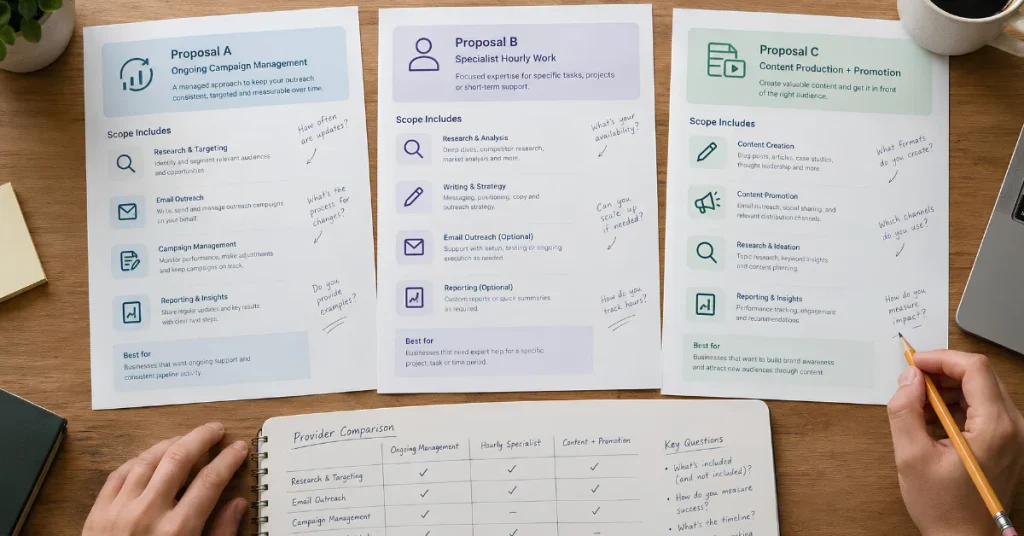
Here’s what I suggest: select suppliers whose delivery method suits your requirements, then compare identical written scopes. A content engine is not the same as a placement campaign and therefore represents two separate purchases.

7. Compare pricing models—not just price per link
The price for the manual backlink service will vary depending on the work being purchased.
| Model | What you pay for | What to check |
| Monthly retainer | Ongoing strategy and execution | Included content, outreach scope, and reporting |
| Hourly outreach | Specialist time | Time records, responsibilities, and progress reviews |
| Per-placement | A defined placement deliverable | Acceptance criteria, payment arrangements, and replacement terms |
| Content-led program | Assets and promotion intended to earn citations | Production costs and uncertain link volume |
For example, Link Fish Media charges $1,050 a month for a basic package that includes three links and offers an average package at $5,000 per month. These are the figures that the company advertises—not the average for the US market nor a guarantee that all campaigns will fall within that range.
Stellar SEO outlines its hourly, custom outreach service and its pay-per-link service, explaining why a cost-per-backlink comparison can mask very different kinds of work.
Ask for a detailed quote that covers research, writing, publisher payments if needed, approvals, reporting, and ongoing monitoring in that order.
If you need help understanding your starting position, an independent backlink profile review might be more helpful than simply buying a package.
8. Demand a report you can verify
A single monthly count isn’t enough.
OuterBox provides information on live placement URLs, target URLs, anchor text, context, publication dates, qualification, and current status. Use that as a starting point for reporting requirements.
Ask for:
- Source URL and publisher.
- Target URL.
- Anchor text and surrounding context.
- Publication date and last-check date.
- Link attributes.
- Placement type and compensation disclosure.
- Live, changed, or removed status.
- A short explanation of relevance.
Separate delivery from outcomes. Delivery shows what the team did; outcomes show changes in referral visits, target-page visibility, leads, and sales.
Delivery tells you what the team did. Outcomes show changes in referral visits, target-page visibility, leads, and sales. Do not assume a ranking increase proves that one backlink caused it.

9. Set approval rules and realistic expectations
Agree on publisher exclusions, target pages, content review, compensation policies, and replacement terms before outreach starts.
SEO.co explicitly describes publisher approval before pitching. Other providers may use different workflows, so never assume approval rights are included.
Also separate two timelines:
- Time to obtain and publish placements.
- Time to evaluate search and business performance.
Sure Oak says it generally sees results within three to six months, depending on competition. Siege Media’s different, content-led model says initial links commonly arrive in month four. These are provider-specific expectations, not a universal timetable.
Ask what the agency will do if outreach does not find many good opportunities. A promise to report the problem and adjust the approach is more helpful than a guarantee of high rankings.

10. Frequently Asked Questions
1. What is included in a manual link-building service?
Common elements include strategy, competitor research, prospecting, vetting, outreach, content coordination, and reporting. Confirm writing and monitoring separately; scopes differ.
2. How do agencies find relevant websites?
Methods include competitor analysis, search operators, topical research, and publisher relationships. Sure Oak describes these directly.
3. Are manual backlink services safe?
Not automatically. The purpose and nature of the links matter more than whether someone pitched them by hand.
4. Do services include guest posting and writing?
Some do. Sure Oak and SEO.co describe content support, but your agreement should specify research, drafts, revisions, and approvals.
5. Can a service guarantee first-page Google rankings?
Treat that promise as a reason to ask harder questions. A placement commitment is not control over search results; Google does not even guarantee indexing or serving eligible content.
6. Do US agencies obtain links only from US websites?
Do not assume so. Specify audience geography in the brief rather than treating the agency’s address as proof of publisher reach.
7. Do agencies offer white-label services?
Yes. Sure Oak, Stellar SEO, and Link Fish Media describe white-label delivery. Clarify confidentiality, branding, reporting, and client ownership.
8. Can outreach support local SEO?
Relevant local media, organizations, and industry resources can support a local campaign. Outerbox describes these opportunities; relevance still matters.
9. How many backlinks do I need?
There is no useful universal purchase quantity. Ask the provider to justify its proposed scope against your pages, competitors, resources, and goals.
10 . Are manual backlinks different from link-building packages?
“Manual” describes a process; “package” describes how work is sold. A package can include manual work. Inspect the method, not just the label.
Focus on the process, not just the promises.
The right manual link building agency should explain what it pursues, what it rejects, what you approve, and what appears in your report.
Before booking a sales call, request three things: a sample report, a written quality checklist, and a clear explanation of publisher payments.
Then compare the answers you receive, not just the dashboard visuals.