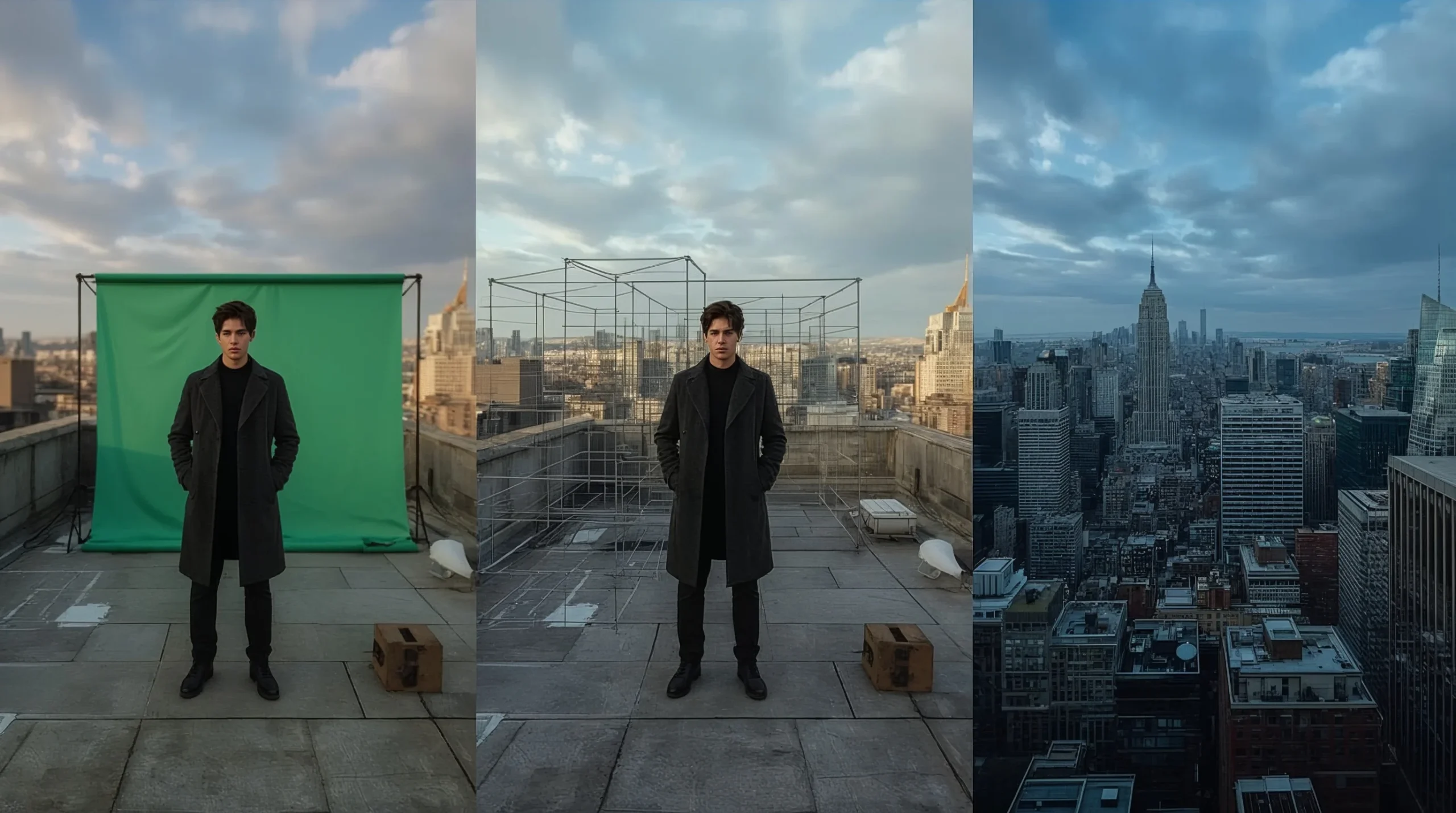
A successful shot depends on the essentials: strong performance, attractive lighting, and the right technical support.
Sometimes the challenge is the opposite: you have a perfectly ordinary parking lot, but the story requires a city that does not exist.
The two issues should be discussed together: VFX.
Professional VFX services can remove distractions, create impossible scenes, and combine real footage with digital elements. The results may be dramatic and showy or so subtle that no one notices any work has been done. For instance, StudioPost offers services such as wire removal and reflection cleanup, as well as green-screen keying and compositing.
The hard part is not deciding whether the visual effects look impressive; it is defining the buying scope, figuring out what to buy, when to bring in a studio, and how to keep a good idea from turning into an expensive guessing game.
A practical way to plan your production exists.
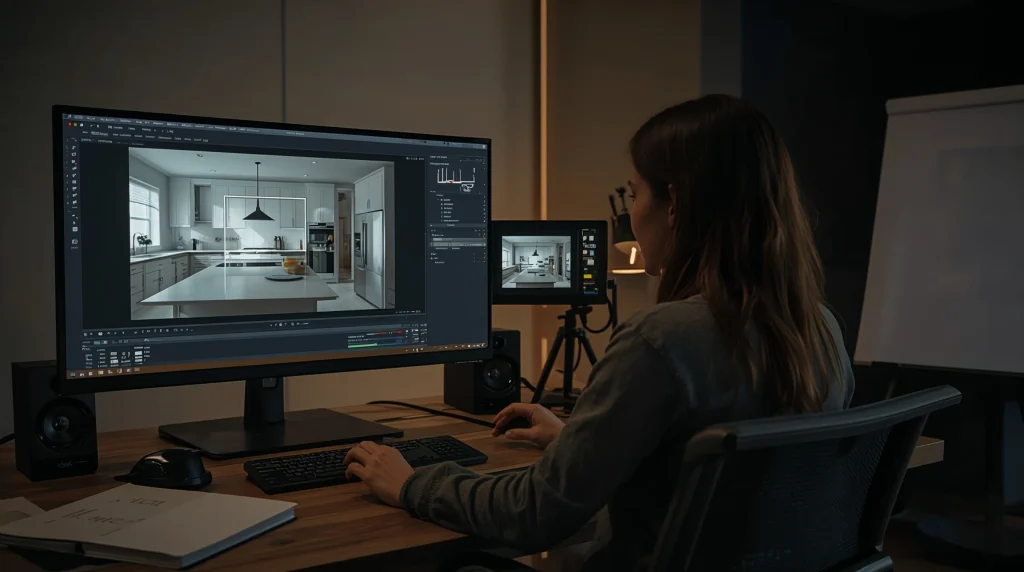
The examples below are purely hypothetical and should not be regarded as case studies of actual clients.
Table of Contents
1. What are VFX services?
VFX services involve production work that creates, changes, or combines images for a final shot.
This could include removing a safety wire, changing the background, inserting a digital element, or extending a physical location into something much larger. Providers might handle the whole sequence or help another studio with specific tasks such as rotoscoping, painting, tracking, and cleanup.
Imagine that visual effects are like a toolbox rather than a single ‘make it cinematic’ button.
VFX vs. CGI vs. practical effects
For this guide, the useful distinction is:
| Term | What it describes | Simple example |
| VFX | Creating or manipulating imagery to build the finished shot | Combining an actor, a replacement background, and a digital vehicle |
| CGI | Computer-generated imagery used within that work | Creating the vehicle |
| Practical effects | Physical effects captured during filming | A real rain rig or physical creature prop |
Practical effects are created on set. CGI is fully digital. VFX combines and modifies images to finish the shot. These approaches can work together, not separately. ILM’s own production coverage discusses balancing handcrafted approaches with modern visual-effects demands.
The question when it comes to buying is not ‘Which technique is the best?’ but ‘Which combination should be used for this shot?’
2. Seven professional VFX services worth understanding
You don’t need to use fluent production jargon, but you should be able to identify the various tasks in your brief.
Compositing and green-screen work
Compositing combines different image elements so they look like they belong in the same scene.
Green-screen compositing services involve more than deleting a colored background. Edges, reflections, color spill, tracking, and the relationship between foreground and background all need attention. StudioPost advertises blue- and green-screen keying, compositing, and 3D tracking.
Rotoscoping
Rotoscoping separates a subject or object so artists can work on it separately.
Hair, motion blur, and overlapping movement can make that isolation demanding. Studio8FX specifically lists articulated roto, hair detail, and motion-blur handling within its rotoscoping services.
Paint, cleanup, and wire removal
VFX paint and cleanup services remove unwanted details and repair the surrounding image.
Examples include production equipment, tracking markers, wires, and distracting reflections. Both StudioPost and Studio8FX advertise these kinds of invisible fixes.
A useful question: what should appear behind the removed object? That missing information matters.
3D camera tracking and matchmove
Tracking follows movement so digital additions stay aligned with filmed footage.
If a replacement sign appears to slide across a building, the illusion falls apart. Studio8FX describes camera tracks, object tracks, and lens-aware solves as support for downstream CG and compositing.
CGI objects, characters, and animation
CGI visual effects services can involve building digital assets and bringing them into a shot.
Ask which stages the quote includes: modeling, surface detail, animation, lighting, rendering, and final integration. “Create a creature” is a creative request; it is not yet a complete scope. ILM and DNEG both offer visual effects and animation.
Digital environments
Environment work can expand what you filmed rather than replace everything.
For example, your foreground street might remain real while faraway buildings become digital. Ask for references that fulfill the required realism—not simply the most dramatic image in a studio’s reel.
Pre-production and on-set support
Some VFX production services start before filming.
StudioPost offers pre-production meetings and on-set consultation; Digital Domain describes support spanning visualization, on-set work, and final visual effects.
My recommendation: involve the effects team before the shoot when the shot depends on digital integration. A short planning conversation is easier than discovering a missing requirement after the location is gone.
3. Match visual effects services to your project
A feature film and a six-second ad may need similar tools, but they need different production plans.
| Project | Questions to settle early |
| Film or episodic television | How many shots, recurring assets, and approval layers are involved? |
| Commercial | Which product details, claims, and brand elements must remain accurate? |
| Music video | Which moments need precise realism, and which allow stylized treatment? |
| Social campaign | Which crops, durations, and platform versions are required? |
| Branded digital film | Who approves the work, and what is the final delivery destination? |
Digital Domain explicitly serves film, television, and immersive content. That breadth shows why you should review the provider’s relevant work rather than assume every visual effects company handles every format equally well.
For an ad, ask to see comparable product shots. For a film, look for matching lighting, camera movement, and scene complexity.
A beautiful spaceship is not automatically proof of excellent cosmetic cleanup.
4. How VFX production works: Six practical stages
Use these stages as a planning framework. Your selected studio may organize them differently.
Step 1: Define the result
Describe what must change and what must remain untouched.
“Remove the background pedestrian while preserving the actor’s coat and shadow” is useful. “Make this cleaner” invites interpretation.
Include visual references, but explain what you like about them.
Step 2: Review the footage
Have the provider review the actual material before committing to a final scope.
Studio8FX asks prospective clients for shot count, service requirements, schedule pressure, and security requirements. Its workflow emphasizes reviewable work and organized handoffs.
Step 3: Confirm the shot list and quote
Assign each shot an ID. Record its duration, requested work, dependencies, and delivery date.
Keep this organized in a VFX shot-list template.
Step 4: Approve the look
For subjective work, agree on a representative frame or test before developing every shot.
Define what “approved” means. An approved concept is not necessarily an approved final animation.
Step 5: Review versions
Give consolidated notes with shot IDs and frame references.
“Reduce the reflection from frames 42–58” is actionable. “Something feels weird” is an opening discussion, not a finishing note.
Step 6: Check final delivery
Review technical quality and appearance: filenames, resolution, frame rate, color handling, handles, and required versions.
Use a post-production delivery checklist to avoid a last-minute scavenger hunt.
5. How much do professional VFX services cost?
There is no responsible universal price for a finished minute.
A minute containing one modest cleanup shot is a different job from a minute featuring moving cameras, digital characters, and a simulated environment.
Request shot-based estimates with explicit assumptions. Studio8FX’s intake requirements—shot count, tasks, schedule, and security—show why a useful scope needs more than the video’s total runtime.
| Cost driver | What to clarify |
| Shot duration | How many frames need work? |
| Visibility and overlap | Does something cross in front of the affected area? |
| Camera movement | What tracking or reconstruction is required? |
| Asset creation | Are usable models available, or must assets be built? |
| Realism | What reference defines an acceptable result? |
| Revisions | How many rounds are included? |
| Versions | Are alternate crops and edits separate deliverables? |
| Schedule | What milestones and dependencies determine delivery? |
For affordable VFX services for filmmakers, define the buying scope before reducing quality.
Prioritize the shots that carry the story. Remove unnecessary variations. Avoid commissioning a detailed digital asset that appears once, far away, unless the creative result genuinely needs it.
6. What should you send a VFX studio for a quote?
Send a short, organized brief containing:
- Shot IDs, durations, and timecodes.
- Available footage or secure review access.
- A plain-English description of each change.
- Reference images or videos.
- Existing assets and their usage rights.
- Deadline and review milestones.
- Intended resolution, frame rate, and aspect ratios.
- Color-pipeline requirements.
- Confidentiality and transfer requirements.
- Expected approval process.
Then ask what is missing.
Do not invent technical specifications to make the brief look complete. Agree on them with the provider, and define the scope of work together.
Start with a VFX project brief template, then tailor it to your production.
7. How to choose the right VFX company
Treat the showreel as an introduction, not the entire interview.
Ask for comparable work
Look for the same kind of challenge: difficult hair, reflective packaging, handheld footage, or realistic creature integration.
Breakdowns can help you understand what the team actually contributed.
Confirm who owns the work
Ask who supervises the shots, communicates with you, and approves outgoing versions.
If you need US-based work or restricted data access, put that requirement in writing. A US office does not mean every artist works domestically: Digital Domain describes a global studio network, while Studio8FX identifies Los Angeles production leadership with global execution capacity.
Consider a paid test
For a new relationship, a representative test can make expectations concrete.
Judge the result, communication, delivery discipline, and response to notes—not just speed.
For a tightly defined task, you might compare freelance cleanup specialists. For a connected sequence with demanding supervision and security requirements, evaluate a studio’s complete production setup. Compare both options by scope, oversight, and security needs before deciding.
8. VFX providers to research for your shortlist
This is a capability-based starting point, not a quality ranking or a declaration about current availability.
| Provider | Advertised capabilities | Useful discussion starter |
| Industrial Light & Magic | Visual effects, StageCraft, visual development, feature animation, immersive entertainment | Large-scale creative and technical requirements. |
| Digital Domain | Visualization, on-set support, final VFX for film, television, and immersive content | Coordination across production stages. |
| DNEG | VFX, animation, and creative technologies; lists Los Angeles among its locations | Film, television, or immersive project scope. |
| StudioPost | Compositing, keying, tracking, cleanup, wire removal, on-set consultation | Episodic or theatrical finishing needs. |
| Studio8FX | Roto, paint, cleanup, tracking, matchmove, outsourcing support | Specialist tasks or overflow production support. |
Use StudioPost’s VFX service breakdown and Studio8FX’s production-support services as examples of how providers describe scope.
Request current availability, relevant samples, delivery terms, and a project-specific quote before choosing.
9. Frequently Asked Questions
1. Can VFX remove unwanted objects, wires, or people?
Yes—providers advertise equipment, personnel, wire, and object removal. Feasibility and effort still require reviewing the footage and the area that must be reconstructed.
2. Can visual effects be added after filming?
Yes. Cleanup, tracking, and compositing are established services. Send the footage for assessment before assuming every requested change is equally straightforward.
3. Do studios offer green-screen and blue-screen work?
Some do. StudioPost explicitly lists both, along with tracking and compositing. Confirm the service and request comparable examples.
4. Can a studio create realistic CGI characters or environments?
Studios offer digital visual effects and animation capabilities, but you should verify the specific asset type, realism target, and integration requirements through relevant samples and tests.
5. How long does a VFX project take?
There is no dependable universal timeline. Ask for milestones tied to your shot list, asset dependencies, feedback windows, and delivery requirements rather than accepting a vague final date.
6. What footage formats should I provide?
Agree with the selected studio before turnover. Confirm source format, resolution, frame rate, color information, handles, naming, and final delivery specifications.
7. How should revisions and approvals work?
Define included rounds, consolidated feedback, approval responsibility, and the treatment of scope changes in writing. Keep creative approval separate from technical delivery acceptance.
10. Plan the shot before you buy the effect
The best professional VFX services solve a specific production problem. They do not simply add visual noise.
Choose a provider whose work matches your needs. Send a clear brief. Agree on revisions and delivery requirements. Give the team ample context to solve the right problem.
Before requesting proposals, prepare three things: your shot list, your references, and your deadline.
Then request a VFX project assessment with a brief that explains what the audience should see—and what they should never notice.