A game doesn’t become good just because you glued a token to it.
That old trick has aged about as well as a 2017 crypto Twitter profile picture.
The strongest play-to-earn game development services start with a simple idea: build a game people would happily play even if nobody mentioned NFTs, tokens, wallets, or blockchain at the first loading screen. Add digital ownership and rewards only if they improve the experience.
For companies entering gaming, blockchain, digital assets, or virtual economies, that is the real opportunity. In practice, a smart P2E game can give players meaningful ownership, a reason to compete, collectible assets, and a living economy. But a poorly planned one can become a very expensive spreadsheet wearing a dragon costume.
This guide explains what modern P2E game development looks like, what services you need, how much a project may cost, and how to choose a play-to-earn game development company that understands both gameplay and Web3 reality. First, let’s look at what these services actually cover.
Quick truth: Modern buyers increasingly use terms like Web3 gaming, blockchain game development, and play-and-own game development because they want sustainable gameplay and ownership—not empty “earn money while gaming” promises. That language shift reflects a shift in priorities.
Table of Contents
What Are Play-to-Earn Game Development Services?
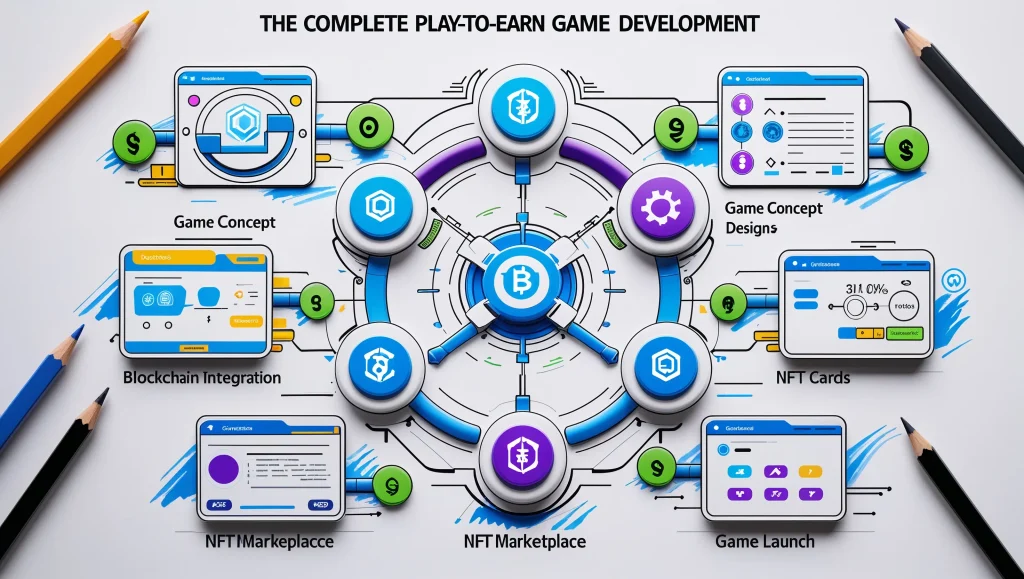
Play-to-earn game development services cover the end-to-end process of building games where players can receive digital rewards through gameplay, achievements, competitions, crafting, trading, tournaments, or community participation. These services typically include gameplay design, blockchain integration, smart contracts, tokenomics, wallet onboarding, marketplace logic, security planning, and live operations support.
Those rewards may include:
- In-game currencies
- Tradeable tokens
- NFT characters, skins, land, equipment, or collectibles
- Tournament prizes
- Marketplace revenue shares
- Unlockable digital items
- Reputation points or non-transferable achievements
A reliable P2E game development company does more than write smart contracts. It should help you connect the whole machine: gameplay, art, multiplayer systems, wallet onboarding, tokenomics, marketplace logic, security, compliance planning, and live operations support. That coordination matters because each part affects the others.
Think of it like building a theme park. The blockchain is not the roller coaster. It is more like the ticketing system, the ownership ledger, and the backstage accounting. Players remember the roller coaster.
Core services in a P2E game project
| Service area | What it includes | Why it matters |
| Game concept and design | Genre selection, core loop, progression, combat, quests, retention design | Makes the game enjoyable before rewards enter the picture |
| Unity or Unreal development | Mobile, PC, browser, console, or cross-platform production | Determines visual quality, speed, performance, and scale |
| Blockchain game development | Chain selection, APIs, transaction architecture, asset ownership | Connects gameplay to verifiable ownership and rewards |
| NFT game development | NFT characters, skins, weapons, land, collectibles, metadata | Useful when assets are unique, scarce, or tradeable |
| Smart contract development for games | Minting, reward distribution, marketplaces, staking, access rules | Protects core economic and ownership logic |
| Blockchain wallet integration for games | Embedded wallets, login, recovery, transaction signing | Reduces the “wait, where is my seed phrase?” moment |
| Tokenomics design | Currency supply, reward emissions, sinks, utility, simulations | Prevents a reward economy from collapsing under its own weight |
| NFT marketplace development for games | Buying, selling, listing, royalties, inventory display | Gives players a place to trade approved game assets |
| Security and audits | Contract audit, anti-cheat, fraud detection, access controls | Protects players, your treasury, your reputation, and your sleep |
| Web3 game launch and live operations | Analytics, balancing, events, community tools, economy monitoring | Keeps the game healthy after launch |
P2E, Play-and-Own, and Web3 Gaming: What’s the Difference?
The language has changed because the market has learned a few hard lessons.
Early P2E projects often led with rewards. Players showed up, farmed tokens, and left when rewards dropped. It was less “gaming revolution” and more “seasonal part-time job with cartoon swords.”
Today, serious teams focus on play-and-own. The idea is straightforward: play because the game is fun; own because ownership adds value, flexibility, status, or creativity. That is the cleaner direction the market has moved toward.
| Model | Main focus | Best use case | Biggest risk |
| Play-to-earn | Players receive rewards for participation or performance | Competitive games, quests, tournaments, community economies | Reward farming and inflation |
| Play-and-own | Fun gameplay plus player-owned assets | Collectible RPGs, sports games, strategy titles, virtual worlds | Building ownership features nobody needs |
| Web3 gaming | Broad category covering wallets, assets, marketplaces, tokens, and blockchain infrastructure | Any game using blockchain-enabled features | Treating Web3 as a gimmick instead of product infrastructure |
| GameFi development | Gaming blended with financial mechanics | Staking, liquidity, tokenized economies, reward platforms | Regulation, complexity, speculative behavior |
The best approach is not “How do we make players earn?” It is “What does ownership allow players to do that they could not do before?”
For example, a rare racing chassis might be upgraded through real gameplay, rented for a tournament, traded in a player marketplace, or used as an entry pass for a special event. That has product logic. By contrast, a random token drop after tapping a button 500 times does not.
10 Must-Have Play-to-Earn Game Development Services
1. Gameplay-First Game Design
Your game needs a satisfying core loop before it needs a token. That loop could be racing, card battles, survival, strategy, sports management, city building, role-playing, or social competition.
Ask your development partner:
- What makes players return tomorrow?
- What makes skill matter?
- What can players master over time?
- Can the game retain users without cash-out rewards?
- What does the first ten minutes feel like?
A good agency will talk about retention, progression, balance, and player behavior—not just NFTs and chain IDs.
2. Custom P2E Game Development
Custom play-to-earn game development means designing the game around your audience, business model, art direction, and economy. It is not a template with different colors and a token ticker bolted to the footer.
This may include:
- Original game mechanics
- Custom 2D or 3D art
- Character design
- Multiplayer systems
- Mobile, PC, browser, or cross-platform builds
- User accounts and social features
- Competitive modes and leaderboards
- Player progression and inventory systems
For a startup, a playable vertical slice is often smarter than going straight into a giant build. It lets you test the fun factor, art style, wallet UX, and reward loop before you buy the full buffet.
3. Blockchain Game Development and Chain Selection
No single blockchain is universally “best” for every P2E game. The right choice depends on player volume, transaction cost, technical tooling, marketplace needs, security requirements, ecosystem support, and your chosen platforms, so the service scope should include chain selection.
Common options often include Ethereum scaling networks, Polygon, Solana, Avalanche, and gaming-oriented infrastructure.
| Decision factor | Why it matters |
| Transaction fees | Small in-game actions should not feel expensive |
| Transaction speed | Players will not tolerate long waits after a match |
| Developer ecosystem | Mature tools can reduce cost and launch risk |
| Wallet experience | Frictionless login matters more than crypto purity |
| Marketplace compatibility | Asset trading needs reliable infrastructure |
| Security model | Your economy is only as safe as its weakest integration |
| Platform support | Mobile, PC, web, and console have different constraints |
Game-oriented platforms can also reduce the amount of infrastructure a studio has to build from scratch. For example, Immutable offers Unity and Unreal SDKs that support authentication, wallet functions, and blockchain interactions across several major platforms. That can simplify the path from setup to launch.
4. NFT Character and Asset Development
Do P2E games need NFTs? No.
A game can still use on-chain or off-chain rewards without minting every sword, shoe, pixel, or suspiciously shiny potato. NFTs make the most sense when a player needs verifiable ownership of an item that is unique, limited, tradable, or valuable across a broader ecosystem. In those cases, they add clear value.
Strong NFT use cases include:
- Limited-edition cosmetics
- Character ownership
- Rare weapons or equipment
- Land plots in virtual worlds
- Membership passes
- Tournament trophies
- Digital collectibles
- Crafting blueprints
- Creator-made items
Weak use cases include anything that should live in a normal database. If every common healing potion is an NFT, you may be creating a very fancy inventory problem.
5. Smart Contract Development for Games
Smart contracts can control high-value game functions, including asset minting, ownership, reward payouts, marketplace rules, token issuance, and access permissions. Scope smart contract development to the specific game functions you need, not as a standalone task. That keeps the work tied to the game itself.
Because contracts can hold valuable assets and may be difficult to change after deployment, plan security from day one. Next, establish a clear audit process.
A professional P2E game smart contract audit process should address:
- Independent code audits
- Role-based permissions
- Multi-signature controls for treasury functions
- Upgrade and emergency-pause policies
- Transaction monitoring
- Contract testing under edge cases
- Incident-response procedures
- Clear ownership of administration keys
Do not accept “we tested it internally” as the full security plan. That is like asking a restaurant to inspect its own kitchen and then giving it a gold sticker.
6. Blockchain Wallet Integration for Games
The phrase “connect your wallet” can still scare away mainstream players. That is why wallet onboarding deserves product-level attention and should be defined as part of the game experience, not a separate technical add-on.
Modern options include:
- Embedded wallets
- Custodial wallets
- Non-custodial wallets
- Email or social login
- Guest accounts that upgrade later
- Wallet recovery tools
- Gas-fee abstraction
- In-game transaction confirmations
The goal is not to force every player to become a blockchain expert. The goal is to let them play.
Immutable’s Unity and Unreal tooling is designed around game authentication and wallet experiences, including support for common game-development environments and platforms.
7. Blockchain Game Tokenomics Design
Tokenomics is not a one-time diagram for an investor deck. It is the operating system of your game economy, so the scope should cover reward flows, sinks, spending behavior, and player incentives.
A sustainable in-game token economy design needs clear answers to uncomfortable questions:
- Where do rewards come from?
- Why would players spend or use them?
- What removes currency from circulation?
- What happens when player growth slows?
- Can bots exploit the reward model?
- Does spending create real utility or just artificial scarcity?
- Can a casual player enjoy the game without constantly trading?
A strong economy usually has both sources and sinks.
| Economy element | Example |
| Source | Winning a ranked match, completing a difficult quest, placing in a tournament |
| Sink | Crafting, cosmetic upgrades, tournament entry, guild projects, repairs, premium events |
| Utility | Unlocking content, improving customization, accessing competition, trading |
| Control mechanism | Daily caps, seasonal resets, reward tiers, dynamic emissions, anti-bot checks |
Reward players for skill, creativity, meaningful contribution, and healthy participation—not merely time spent with an auto-clicker running in the background.
8. NFT Marketplace Development for Games
An in-game marketplace can become a major product feature, but it should feel like part of the game—not an awkward financial dashboard hiding behind a sword icon. Its scope should include discovery, pricing, trading, and player visibility.
A useful marketplace should include:
- Asset search and filters
- Item history and rarity details
- Secure listings and purchases
- Fraud monitoring
- Royalties where appropriate
- Inventory synchronization
- Pricing analytics
- Currency display
- Clear player disclosures
- Responsive support and dispute workflows
If your game includes trading, make the economy legible. Players should understand what they own, what it does, what it costs, and what risks exist.
9. Anti-Cheat, Fraud Prevention, and Compliance Planning
Any reward system attracts bad actors. It is a law of the internet, somewhere between “someone will post spoilers” and “someone will name their guild after a sandwich.”
Your development partner should plan for:
- Bot detection
- Device fingerprinting where lawful and appropriate
- Rate limits
- Behavior monitoring
- Account-risk scoring
- Anti-cheat systems
- Marketplace fraud controls
- Wallet-risk monitoring
- Geofencing
- Age gating
- KYC/AML workflows where required
- Tax and consumer disclosures
For U.S. launches, legal review is not optional when rewards can be cashed out or traded. Securities considerations, prize-promotion rules, gambling laws, money-transmission issues, consumer protection, taxes, and state-level differences may apply. Engage qualified U.S. counsel before launch.
For games where cash-out and compliance are central, payout providers such as ZBD market embedded payout flows that include KYC, AML, sanctions screening, fraud measures, and multiple withdrawal options for U.S. and European players.
10. Web3 Game Launch and Live Operations
A P2E game is never truly “done.” The launch is when the real economic data begins.
Live operations should include:
- Economy dashboards
- Player retention monitoring
- Reward emission tracking
- A/B testing
- Seasonal content
- Community moderation
- Balance patches
- Customer support
- Marketplace monitoring
- Security updates
- Fraud-response procedures
If tokenomics is the engine, live operations is the person checking the oil before the road trip turns into a roadside documentary.
How Much Does Play-to-Earn Game Development Cost?
The honest answer: it depends on what you’re building.
A lightweight prototype with basic wallet integration costs far less than a polished multiplayer RPG with custom 3D art, cross-platform support, smart contracts, a marketplace, security audits, and ongoing operations.
Some industry estimates place broad blockchain-game project ranges from roughly $30,000 to $250,000 or more, but treat any public number as directional, not a promise. Your real price depends on scope, talent level, production quality, compliance needs, and security requirements.
| Project type | Typical scope | Budget reality |
| Proof of concept | Basic gameplay loop, wallet test, limited rewards | Often the lowest-cost validation stage |
| Vertical slice | Polished sample level, representative art, early economy model | Useful for fundraising, user testing, and vendor evaluation |
| Mobile P2E game | Mobile gameplay, account systems, wallet UX, rewards | Cost rises with art, backend, multiplayer, and store requirements |
| Multiplayer blockchain game | Real-time systems, anti-cheat, servers, progression, Web3 features | Requires significant engineering and QA investment |
| Full Web3 ecosystem | Game, marketplace, NFTs, tokenomics, smart contracts, analytics, live ops | Highest complexity and usually the largest budget |
What drives P2E game development cost?
- Game genre and platform count
- 2D versus high-end 3D production
- Unity versus Unreal development
- Single-player versus real-time multiplayer
- Custom art, animation, sound, and cinematic work
- Smart contract complexity
- NFT and marketplace features
- Wallet and identity flows
- Blockchain integration
- Security audits
- Anti-cheat and fraud prevention
- Compliance planning
- Post-launch live operations
The best way to control costs is not to cut security or skip design. Instead, scope intelligently. Build the smallest version that proves the game is fun, the onboarding works, and the economy is understandable. How Long Does It Take to Build a P2E Game?
A proof of concept may take weeks or a few months. A polished production title can take many months or longer.
Here is a practical planning view:
| Phase | Typical purpose | Main output |
| Discovery | Validate business model, audience, risks, and game idea | Product brief, roadmap, technical plan |
| Pre-production | Design gameplay, economy, art direction, architecture | Game design document, tokenomics model, prototype |
| Vertical slice | Prove the player experience | Playable high-quality sample |
| Full production | Build content, systems, multiplayer, art, and integrations | Alpha and beta versions |
| Security and testing | Audit contracts, test gameplay, remove bugs, tune economy | Launch candidate |
| Soft launch | Collect real user feedback in a controlled market | Retention, economy, and funnel insights |
| Full launch and live ops | Scale, update, secure, and optimize | Ongoing game operations |
A rushed launch can be expensive. By contrast, a controlled soft launch can save a company from learning painful lessons in public. How to Choose a Play-to-Earn Game Development Company
A polished website doesn’t prove an agency can ship a reliable game. A tokenomics diagram with neon arrows is not proof either.
When evaluating a Web3 game development agency in the USA or a global production partner, prioritize evidence. In particular, look for proof that the team can deliver reliably. Your vendor-selection checklist
- Ask to play real shipped games.
- Do not settle for screenshots, trailers, or vague claims about “contributing to the ecosystem.” Instead, ask what the team actually built. Request a playable vertical slice.
- Before funding a full project, test the core loop, onboarding, wallet flow, and first version of the reward system. That way, you can validate the experience early. Confirm IP and asset ownership.
- Your contract should clearly assign source code, art, domain accounts, treasury controls, wallets, smart-contract administration rights, and documentation to your company. That clarity helps avoid ownership confusion later. Ask for a written tokenomics model.
- It should cover emissions, sinks, player acquisition assumptions, player behavior, farming risks, liquidity assumptions, and stress scenarios. In this way, the model supports more realistic planning. Require independent smart-contract audits.
- Ask who performs the audit, how critical findings are addressed, and whether remediation is included in scope. This clarifies the review process before launch. Check live-operations capability.
- You need more than a launch team. You need monitoring, updates, balance patches, support tools, and economy oversight after launch. Validate U.S. regulatory readiness.
- AA vendor doesn’t need to be your law firm, but it should know when to involve legal specialists and how compliance affects product design. In practice, that keeps legal needs tied to the build process. Review the team composition.
- You want game designers, Unity or Unreal developers, backend engineers, blockchain engineers, UI/UX designers, QA specialists, security experts, and producers—not a single generalist trying to juggle every flaming sword.
U.S. Service Options for P2E and Web3 Gaming
The right provider depends on whether you need a full-service production agency, blockchain specialists, infrastructure support, payout handling, publishing support, or a combination of these services.
| Provider or platform | Relevant strengths | Best fit |
| RisingMax | Markets custom NFT, P2E, Web3, and multi-chain game development | Businesses seeking a U.S.-market-facing custom-build agency |
| SoluLab | P2E mechanics, blockchain integration, NFTs, and reward-driven game concepts | Startups needing blockchain engineering and game-development support |
| NeonForge | Immersive 3D, VR, metaverse, Web3, and smart-contract production | Projects needing high-end visual or immersive game experiences |
| Cobweb Games | Full-service game production, Unity, Unreal, mobile, blockchain features | Teams blending standard game production with Web3 functionality |
| SDLC Corp | GameFi systems, wallets, marketplaces, NFT assets, token rewards | End-to-end builds involving rewards and marketplace architecture |
| PrimaFelicitas | GameFi consulting, NFTs, marketplaces, tokenomics, smart contracts | Founders who want discovery and economy planning with development |
| Infinity-Up | Full-cycle NFT/Web3 game production and P2E ecosystems | Startups seeking a concept-to-launch partner |
| Immutable | Wallet, authentication, game APIs, contracts, Unity/Unreal tooling | Studios with internal game teams needing Web3 infrastructure |
| ZBD | Embedded payouts and reward redemption infrastructure | Games where compliant cash-out is a key product requirement |
| Mythical Games | Publishing, marketplace, player-controlled trading ecosystem | Partnership, distribution, and ecosystem conversations |
SoluLab describes its offering as full-spectrum P2E and blockchain gaming work, covering blockchain technology, NFTs, and tokenomics. Immutable’s documentation also makes it a useful infrastructure option for teams building with Unity or Unreal rather than seeking a conventional work-for-hire studio.
Important: Treat every vendor list as a starting point, not a final verdict. After that, verify current availability, contracts, portfolio claims, security practices, client references, team location, and legal fit before signing.
Frequently Asked Questions
1. What are play-to-earn game development services?
They are services for designing, building, launching, and maintaining games where players can receive digital rewards for gameplay, achievements, competitions, trading, crafting, or participation. They may include game design, blockchain integration, NFT assets, wallets, tokenomics, smart contracts, marketplaces, testing, security, and live operations.
2. How do play-to-earn games work?
A P2E game links player activity to a reward system. Players may earn through quests, ranked matches, tournaments, crafting, trading, staking, or milestones. Blockchain may record ownership of selected assets and support transfers or marketplace trading.
3. Do P2E games need NFTs?
No. NFTs are useful when your game needs verifiable ownership of unique or limited assets, such as characters, skins, equipment, land, or collectibles. They are not necessary for every reward, inventory item, or game mechanic.
4. Which blockchain is best for a P2E game?
The best blockchain depends on your transaction volume, fees, speed, security needs, developer tooling, ecosystem support, platform requirements, and marketplace strategy. Evaluate Ethereum scaling networks, Polygon, Solana, Avalanche, and gaming-specific infrastructure against your actual product requirements.
5. Can an existing game become a P2E game?
Yes. An existing game can add wallet features, NFTs, tokenized rewards, marketplace functionality, smart contracts, or digital ownership systems. However, the team should first check whether these features improve the existing player experience rather than disrupt it.
6. How can players earn rewards without harming game balance?
Tie rewards to skill, useful participation, creativity, scarce contributions, or optional competitions. Use rate limits, anti-bot systems, currency sinks, reward caps, seasonal structures, and constant economic monitoring to reduce farming and inflation.
7. Do players need a crypto wallet?
Often, yes—but the experience does not need to be difficult. Embedded, custodial, and non-custodial wallet models can reduce friction. The best approach depends on player type, regulations, ownership needs, and your product flow.
8. Are P2E games legal in the United States?
The answer depends on the game’s exact mechanics, token design, cash-out flows, state rules, age restrictions, securities issues, consumer-protection obligations, KYC/AML needs, gambling or prize-promotion analysis, and tax treatment. Work with qualified U.S. legal and compliance counsel before launch, especially if rewards have cash value.
Final Takeaway
The future of P2E is not about persuading people to grind for a token. It is about making ownership, competition, creativity, and rewards feel native to a game players already love.
The best play-to-earn game development services combine serious game design with sensible blockchain architecture, careful tokenomics, strong security, smooth wallet onboarding, and ongoing economic monitoring. First, build the game. Then make ownership meaningful. Protect your players. Finally, let the rewards support the experience rather than hijack it. If you are planning a Web3, GameFi, NFT, or play-and-own project, start with a discovery phase and a playable vertical slice. That is the fastest way to test whether your game has a real pulse—or just a very expensive wallet connection screen.