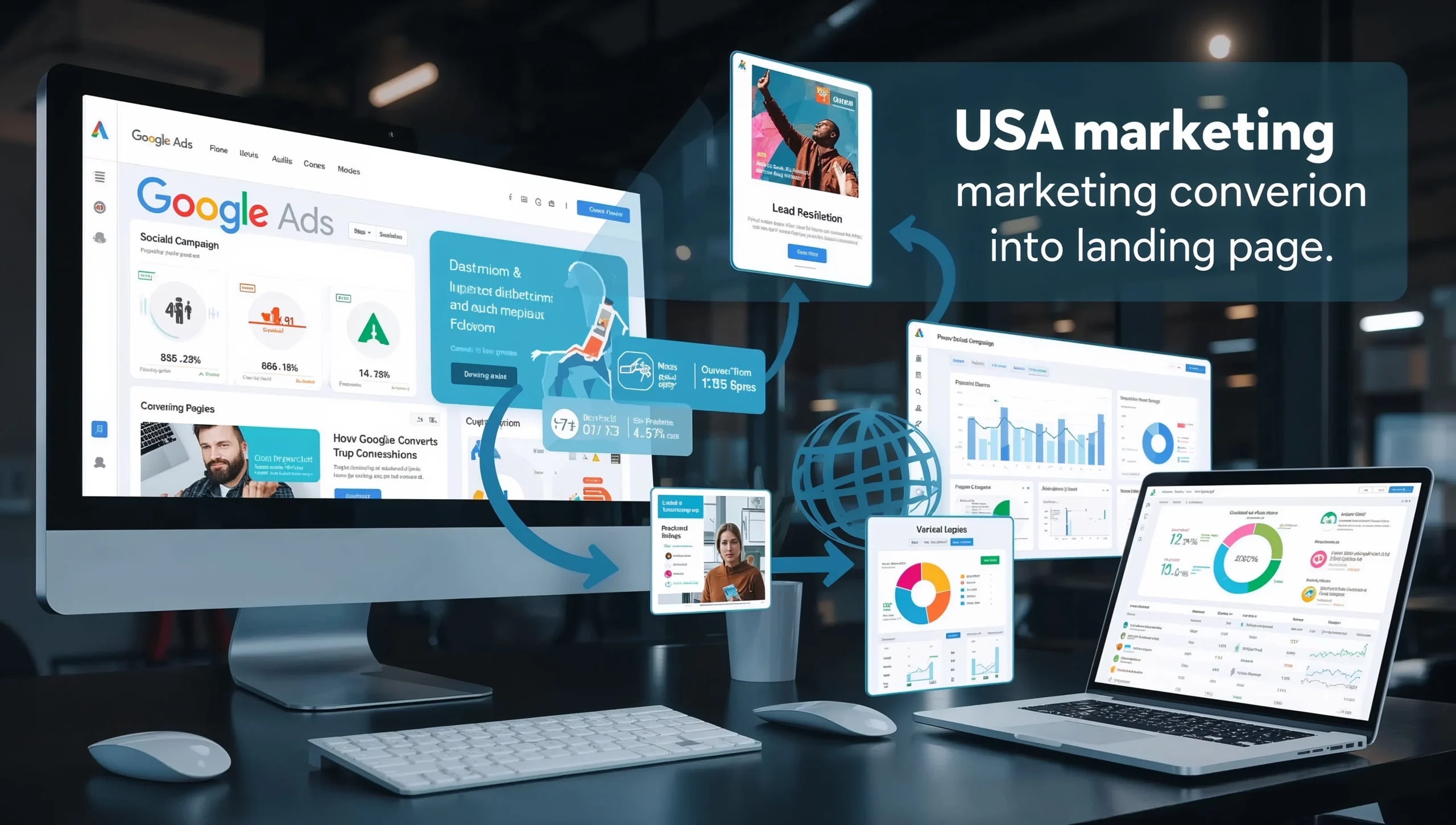
You can spend a small fortune getting people to click your ad. Google Ads, Meta Ads, LinkedIn campaigns, and email promos all bring in traffic—but what happens next matters just as much.
Then you send those visitors to your homepage.
That is like inviting someone to a dinner reservation and pointing them toward a shopping mall food court. Technically, food exists. But the path is unclear, noisy, and full of distractions.
Your Website Gets Traffic. But Does It Get Results?
That is exactly why landing page development services matter: they turn paid attention into a focused path forward.
A professional landing page isn’t just a pretty web page with a bright button. It is a focused conversion path designed around one visitor, one offer, and one clear next step: book a consultation, request a quote, buy a product, register for an event, start a trial, schedule an appointment, or call now.
For service companies, real estate firms, clinics, colleges, SaaS brands, e-commerce stores, financial companies, agencies, restaurants, and event businesses, that focus can be the difference between “we got clicks” and “we got customers.”

In this guide, I will break down what landing page design and development really includes, what it costs in the United States, which platforms make sense, and how to choose a landing page development company without falling for glossy screenshots and vague promises. To start, let’s look at what these services actually are.
Table of Contents
1. What Are Landing Page Development Services?
Landing page development services involve planning, writing, designing, building, testing, and improving a standalone web page built for a specific marketing goal.
That goal could be:
- Generate leads for a roofing company
- Book appointments for a dental clinic
- Get demo requests for a B2B SaaS product
- Sell a limited-edition e-commerce bundle
- Promote a real estate listing
- Register people for a training program
- Capture email subscribers before a product launch
- Drive reservations for a restaurant event
Unlike a regular website page, a landing page should do one job. Not ten jobs. Not a full company biography, careers page, investor relations section, or office pet photo. It should stay focused on that one action. That focus is what makes the next step worth examining.
One job.
A strong landing page design and development process typically includes:
- Audience and offer research
- Campaign and keyword-intent planning
- Wireframes and user-experience planning
- Landing page copywriting and visual design
- Responsive front-end development
- Form, calendar, payment, CRM, and automation integrations
- Google Analytics, Google Tag Manager, pixels, and conversion tracking
- Speed, mobile, accessibility, and browser testing
- Launch support and ongoing conversion-rate optimization
A landing page developer should think like part designer, part developer, part salesperson, and part detective, asking, “Why might this visitor leave before filling out the form?” Those roles become easier to judge when you compare landing pages with regular website pages.

2. Landing Page vs. Website Page: What Is the Difference?
A website is a digital headquarters. A landing page is a campaign closer.
Your website answers broad questions about your brand: who you are, what you offer, where you operate, and why someone should trust you. A dedicated campaign landing page removes the clutter and guides visitors toward one clear action, such as booking, requesting, buying, registering, starting, scheduling, or calling.
| Feature | Regular Website Page | Dedicated Landing Page |
| Primary purpose | Inform and explore | Drive one conversion |
| Navigation | Usually includes menus and many links | Often limited or removed |
| Audience | Broad site visitors | A defined campaign audience |
| Messaging | General business messaging | Matches one ad, offer, or keyword |
| Calls to action | Several possible next steps | One primary CTA |
| Best for | Brand discovery and general SEO | PPC, email, paid social, launches, promotions |
| Measurement | Overall site engagement | Cost per lead, form fills, bookings, revenue, conversion rate |
For paid campaigns, message match matters. If a visitor clicks an ad for “emergency HVAC repair in Dallas” and lands on a generic HVAC homepage, they must hunt for the promised service. That delay creates doubt.
Instead, the landing page should echo the ad’s promise:
- Ad: 24/7 Emergency HVAC Repair in Dallas
- Landing page headline: Fast 24/7 Emergency HVAC Repair in Dallas
- CTA: Call Now or Get a 15-Minute Response
Simple? Yes. Effective? Also yes. Google itself frames landing-page experience as one element used in its Quality Score diagnostic, alongside expected click-through rate and ad relevance. With that in mind, here’s what a high-converting page usually includes.
3. What Does a High-Converting Landing Page Include?
There is no magic button color. If anyone promises a “proven red-button formula,” gently back away while maintaining eye contact.
However, high-converting landing pages usually share several practical elements. The first is a clear, specific headline.
A clear, specific headline
Your headline should answer the visitor’s quiet first question:
“Am I in the right place?”
A weak headline says: “Innovative Solutions for Modern Businesses.”
A stronger headline says: “Get More Qualified Roofing Leads With Google Ads Landing Pages Built to Convert.”
The second one may not win a poetry award. It does something better: it makes sense.
A value proposition people can understand
Explain what the customer gets, who it is for, and why it matters.
For example:
- “Book a same-week dental implant consultation.”
- “Launch your new SaaS feature with a custom Webflow landing page.”
- “Get a free property valuation from a local real estate expert.”
- “Order meal-prep plans built around your fitness goals.”
One primary call to action
Your CTA should be specific and low-friction:
- Get My Free Estimate
- Book a Demo
- Start My Free Trial
- Reserve Your Table
- Request a Consultation
- Download the Guide
“Submit” is technically functional. So is beige wallpaper. Neither inspires much enthusiasm.
Benefits, not just features
Features explain what you do. Benefits explain why the visitor should care.
| Feature | Benefit-focused wording |
| CRM integration | Leads go directly to your sales team with no manual copying |
| Mobile responsive design | Visitors can book or buy comfortably from their phones |
| Appointment calendar | Prospects can choose a time without playing email ping-pong |
| Page-speed optimization | More visitors stay long enough to see your offer |
| A/B testing | You can improve results based on real behavior, not guesses |
Proof and trust signals
Trust is especially important in healthcare, financial services, legal-adjacent services, home services, real estate, and high-ticket B2B sales.
Use relevant proof such as:
- Customer reviews and testimonials
- Before-and-after results
- Case studies
- Certifications and licenses
- Media mentions
- Partner logos
- Secure payment badges
- Privacy reassurance near forms
- Clear policies and contact details
Forms that respect a visitor’s time
If you ask for first name, last name, work email, mobile number, company revenue, and childhood dream before offering a 15-minute consultation, you may have created a form—not a clear lead path.
Ask only for what you need at that stage. For high-intent services, name, email, phone, and a short message may be enough. For low-intent content downloads, name and email can often do the job, so the path to conversion stays simple.
4. What Professional Landing Page Development Includes
A capable landing page development agency does far more than drop your logo into a template and call it a day. It starts with a clear strategy.
Strategy and campaign alignment
Before design begins, the team should understand:
- Who is coming to the page?
- Where is the traffic coming from?
- What search term, ad, social post, or email brought them there?
- What problem do they want solved?
- What offer would feel useful right now?
- What action counts as a conversion?
For PPC, the page must align with the ad copy and the visitor’s intent. For email campaigns, it should continue the conversation started in the inbox. For organic SEO, it should answer the search query in detail while remaining conversion-focused. Once strategy is set, copywriting and visual design turn that direction into the page itself.
Copywriting and visual design
Good landing page copy is clear, organized, and buyer-focused. It avoids fluffy statements that could describe every business in America.
Visual design should support the message, not compete with it. That means:
- Easy-to-scan typography
- Strong contrast
- Clear visual hierarchy
- On-brand colors
- Authentic photos or useful product visuals
- Obvious CTA buttons
- Enough white space to let important information breathe
Responsive landing page development
A mobile-friendly landing page design is not optional. It is table stakes.
Your page should work on phones, tablets, laptops, and large monitors. Forms should be easy to complete with a thumb. Buttons should be comfortably tappable. Text should not require squinting or pinching.
W3C’s mobile accessibility guidance emphasizes responsive layouts, text reflow, touch-friendly controls, and making key content easy to reach on smaller screens.
Integrations and automation
Your page may need to connect with:
- HubSpot
- Salesforce
- Zoho CRM
- Mailchimp
- ActiveCampaign
- Calendly
- Stripe
- Shopify
- PayPal
- GoHighLevel
- Zapier
- Meta Pixel
- LinkedIn Insight Tag
- Google Ads conversion tracking
For a clinic, this may mean an appointment request feeds into a secure workflow. For a SaaS company, it may mean a demo request automatically routes to the right sales rep. For an e-commerce brand, it may mean a promo page passes clean data into checkout. After integrations are in place, tracking and optimization keep the page accountable.
Tracking, QA, and optimization
A launch without tracking is like opening a restaurant without knowing whether anyone ordered or whether the kitchen caught fire.
Professional landing page development should include:
- Google Analytics 4 setup
- Google Tag Manager configuration
- Form-submission tracking
- Phone-click tracking
- Calendar-booking tracking
- Purchase or revenue tracking where applicable
- Ad-platform pixels
- Cross-browser testing
- Device testing
- Page-speed checks
- Broken-link and form testing
Google Analytics identifies a landing page as the first page a visitor sees in a session and provides reporting that helps you compare how those entry pages perform.
5. How Much Do Landing Page Development Services Cost?
The honest answer: it depends on what you actually need.
A basic one-page build with a supplied design and no complex integrations differs greatly from a custom, conversion-focused landing page with original copy, animation, HubSpot workflows, paid-media tracking, accessibility review, and ongoing A/B testing.
| Scope | Typical U.S. Price Range | Usually Includes |
| Basic template-based page | $100–$1,500 | Simple setup, basic mobile styling, form |
| Custom small-business landing page | $1,500–$7,500 | Strategy, copy support, design, development, tracking |
| Advanced custom campaign page | $8,000–$20,000+ | Custom UX, integrations, advanced tracking, detailed QA |
| Ongoing landing page CRO | $2,500–$15,000+ per month | Research, testing, analysis, iterative optimization |
These are broad planning ranges, not universal price guarantees. Your final cost can rise with custom code, advanced animation, compliance needs, complex form logic, multiple page variants, specialized copywriting, platform migrations, and CRM integrations.
One published example: WebFX lists landing-page design package pricing starting at $1,125 per page, though exact deliverables and current pricing should always be confirmed directly with the provider. Meanwhile, Clutch market guidance cited in the supplied research places a single SMB landing page around $1,500–$7,500, with complex enterprise work often costing substantially more.
The key question is not, “What is the cheapest landing page?”
It is, “What is each qualified lead or sale worth to us—and can this page make paid traffic more profitable?”
If a $4,000 page produces just a few extra high-value leads every month, it may quickly pay for itself. If it looks expensive but fails to track leads, match the campaign, or guide users to action, it is merely an expensive digital poster.

6. Which Landing Page Platform Is Best?
The right platform depends on your team, budget, stack, campaign volume, and need for flexibility.
| Platform | Best for | Watch-outs |
| WordPress | Service businesses, SEO content, flexible sites | Quality depends heavily on theme, plugins, and build quality |
| Webflow | Design-led brands, SaaS, visual marketing pages | Requires confident Webflow expertise for advanced work |
| HubSpot | B2B, SaaS, CRM-centered lead generation | Best value when you already use HubSpot |
| Shopify | E-commerce offers, collection pages, product promotions | May require careful theme and checkout integration work |
| Unbounce | Fast campaign launches and testing | Can feel limiting for deeply custom experiences |
| Instapage | Paid-media teams managing many ad campaigns | Often better suited to higher-volume campaign operations |
| Custom code | Unique UX, advanced performance, special integrations | Higher cost and longer build time |
Choose WordPress when
You want flexible content management, SEO-friendly supporting content, and a familiar environment for a service business, local brand, or content-heavy site.
Choose Webflow when
You want sharp visuals, clean responsive design, and marketing flexibility without leaning on a crowded plugin stack.
Choose HubSpot when
Lead routing, lifecycle tracking, marketing automation, and sales visibility matter as much as the page design. HubSpot landing page development can be particularly useful for B2B, education, finance, and SaaS teams.
Choose Shopify when
The landing page’s job is to sell products. It should work smoothly with inventory, product variants, discount codes, carts, and checkout.
Choose a landing page builder when
You need speed, repeatable templates, frequent campaign variations, and practical A/B testing. Platforms such as Unbounce are built to create and optimize conversion-focused pages.
7. Do You Need a Separate Landing Page for Every Campaign?
Not for every tiny variation. But when the audience, offer, intent, or traffic source changes significantly, a separate page is often the better choice.
Consider separate dedicated campaign landing pages when you have:
- Different Google Ads keyword groups
- Different cities or service areas
- Different customer types
- Different pricing offers
- Different ad channels
- Different products or use cases
- Different lead magnets
- Different stages of the buying journey
For example, a financial advisor could use separate pages for:
- Retirement planning consultations
- Tax-efficient investing
- Business-owner succession planning
- Wealth management for physicians
All four audiences may need financial advice. But they do not have the same questions, motivations, or concerns, so the page should match each audience more closely.
A good landing page development company builds this logic into the campaign structure, rather than sending every visitor into one generic funnel and hoping for the best.
8. What Is Conversion-Rate Optimization?
Conversion-rate optimization, or CRO, is the process of improving the percentage of visitors who complete a desired action.
The formula is straightforward:
If an online store receives 1,000 visitors in a month and logs 25 sales, the conversion rate is calculated as:

CRO does not mean changing the button from blue to green and calling it science. It means developing a hypothesis, testing meaningful changes, reviewing the data, and learning from what visitors actually do so decisions improve over time.
A landing page CRO program may test:
- Headlines
- Offer framing
- CTA wording
- Form length
- Testimonial placement
- Pricing presentation
- Hero images
- Video demonstrations
- Trust badges
- Page length
- Mobile layout
- Exit-intent messages
Example CRO hypothesis
Observation: Visitors reach the pricing section, but few request a demo.
Hypothesis: They may be unsure whether the product fits their business size.
Test: Add a short “Who This Is For” section above the CTA, with use cases for small teams, mid-market companies, and enterprise buyers.
Measure: Demo requests, qualified demo rate, and sales opportunities—not just button clicks.
That is why the best landing page optimization services do not treat launch as the finish line. Launch is the starting line for the next decision.

9. How to Choose a Landing Page Development Company
A polished portfolio is useful, but it is not enough to judge fit. Use the next questions to decide how each provider thinks and whether they match your criteria. Focus on criteria that show how well a provider matches your needs.
Ask prospective providers questions that reveal how they think and how they fit your criteria.
Ask about process
- How do you research audience pain points and search intent?
- Do you create a wireframe before visual design?
- Who writes the copy?
- How do you align paid ads and landing-page messaging?
- What is your process for mobile-first design and QA?
- How do you test form submissions and integrations before launch?
Ask about measurement
- Which conversion actions will you track?
- Will you set up GA4, Google Tag Manager, pixels, and event tracking?
- Can you report on calls, form fills, bookings, purchases, and qualified leads?
- How will you distinguish paid traffic from organic traffic?
- Do you offer post-launch testing and reporting?
Ask about ownership
You should get a clear answer about who owns:
- The finished landing page
- Source files
- Copy and creative assets
- The domain and hosting account
- Analytics accounts
- Ad accounts
- CRM forms and automations
- Login credentials
If ownership details feel foggy before the contract, they rarely become clearer later. Resolve ownership now so the decision stays clean.
Ask about relevant experience
Choose a provider with experience in your model:
| Your business type | Experience to look for |
| Local services | Calls, quote forms, local trust signals, service-area messaging |
| Real estate | Listing pages, property inquiry flows, lead routing |
| Healthcare | Appointment requests, trust, privacy-aware forms, clear service info |
| Education | Course signups, program comparison, lead nurturing |
| SaaS | Demo funnels, free trials, use-case pages, CRM workflows |
| E-commerce | Product promotion, mobile checkout flow, offer testing |
| Financial services | Credibility, disclosures, lead qualification, compliant messaging |
| Restaurants and events | Reservations, ticket sales, menus, time-sensitive offers |
10. 7 Reputable U.S.-Focused Options to Research
No single “best” provider fits every business. Choose based on your campaign goals, budget, platform, traffic source, internal resources, and ongoing optimization needs.
| Provider | Best fit | Why consider them |
| SiteTuners | Research-led CRO and ongoing testing | Focuses on user research, behavioral analytics, optimization, and experimentation |
| WebFX | SMB and mid-market integrated marketing | Combines landing page design with broader development, SEO, analytics, and marketing services |
| KlientBoost | PPC, paid social, SaaS, lead generation | Strong fit when paid media and landing-page conversion work need to operate together |
| OuterBox | E-commerce, B2B, SEO, PPC campaigns | Offers strategy, UX, copy, development, QA, analytics, and CRO-oriented work |
| AdVenture Media Group | Google Ads and performance marketing | Relevant for campaign-driven pages, conversion tracking, and PPC alignment |
| ConversionFlow | Conversion testing and optimization | Worth evaluating if ongoing CRO is your main need |
| Orbit Media Studios | Content-led B2B web strategy | Useful for teams that need content, UX, strategy, development, and optimization |
Treat this as a research shortlist, not a universal ranking. Compare each company on relevant examples, testing process, scope, ownership terms, accessibility approach, technical stack experience, and measurement plan before committing.
11. Frequently Asked Questions About Landing Page Development Services
1. What are landing page development services?
They are professional services that plan, design, build, integrate, test, and improve focused web pages intended to drive one goal, such as leads, sales, appointments, registrations, or demo requests.
2. Why does my business need a professionally developed landing page?
A professional page gives campaign traffic a focused path. It can improve message match, reduce distractions, clarify the offer, support tracking, and create a smoother route to conversion.
3. How much do professional landing page development services cost?
A basic page may cost several hundred to a few thousand dollars. Custom conversion-focused work commonly ranges from about $1,500 to $7,500 for SMB projects, while enterprise or integration-heavy pages can cost $8,000 to $20,000 or more. Ongoing CRO is often priced separately.
4. How long does it take to design and develop a landing page?
A simple page can take one to two weeks. A custom page with original copy, integrations, custom design, approvals, and QA may take several weeks. Add time for testing and iteration after launch.
5. Do landing page development services include copywriting and visual design?
They can, but do not assume. Some providers handle end-to-end strategy, copy, UX, design, coding, and testing. Others only build from a design you provide. Confirm this in the scope of work.
6. Can you build landing pages for Google Ads, Meta Ads, LinkedIn Ads, and email campaigns?
Yes. In fact, campaign-specific pages are often most valuable for these channels because they can match the exact audience, offer, and message used in the ad or email.
7. Which platform is best: WordPress, Webflow, Shopify, HubSpot, Unbounce, or custom code?
There is no universal winner. WordPress is flexible, Webflow is design-led, HubSpot excels at CRM-connected lead generation, Shopify suits e-commerce, Unbounce supports fast campaign testing, and custom code fits unique requirements.
8. Will my landing page be mobile responsive and optimized for speed?
It should be. Confirm that the provider tests across screen sizes, compresses and properly serves images, reduces unnecessary code, and checks real mobile usability. W3C guidance also stresses touch-friendly controls, responsive layouts, and readable content on small screens.
9. Can a landing page connect to my CRM, calendar, email platform, and payment gateway?
Usually, yes. Common integrations include HubSpot, Salesforce, Calendly, Mailchimp, ActiveCampaign, Stripe, Shopify, Zapier, and Google tools. Share your full stack before development begins.
10. Do developers set up Google Analytics, Google Tag Manager, and ad pixels?
Many do, but you must include this specifically in your agreement. Make sure every meaningful conversion—forms, calls, bookings, purchases, downloads, and chat leads—is defined and tested.
11. What is conversion-rate optimization, and is it included?
CRO is the ongoing practice of testing and improving the page based on data. Some development packages include an initial optimization pass; continuous research and A/B testing are often a separate monthly service.
12. Can an existing landing page be redesigned instead of rebuilt?
Yes. A landing page redesign service can improve copy, mobile usability, form flow, trust signals, speed, tracking, and CTA clarity without starting from scratch.
13. Do I need a separate page for every service, product, audience, or ad campaign?
Not always. Create separate pages when the audience, offer, location, keyword intent, or traffic source changes and generic messaging would feel vague.
14. How do you ensure the page matches my ad message and target keyword intent?
Start with the campaign structure. The landing page headline, offer, supporting copy, visuals, and CTA should continue the promise made in the ad.
15. Do landing page development services include A/B testing?
Some do. Others offer testing as an add-on or a CRO retainer. Ask what will be tested, how long tests run, what traffic level is needed, and how success will be measured.
16. What content should a high-converting landing page include?
Most pages need a strong offer, clear benefits, relevant visuals, social proof, a concise form or CTA, FAQs, and trust-building details. The exact layout should match the visitor’s intent and the decision’s complexity.
17. Can landing pages rank organically?
Yes. SEO landing page development services can support organic visibility when pages provide genuinely useful content, target realistic search intent, load quickly, work well on mobile, and avoid thin or duplicate content.
18. Who owns the finished page and related assets?
You should clarify this before signing. Ideally, your business owns the completed page, source files, accounts, domain assets, tracking access, content, and creative assets once agreed fees are paid.
Build the Page Your Campaign Deserves
Landing page development services are not about adding more pixels to the internet. They are about creating a clearer conversation between your business and the person who just clicked.
When the page matches the ad, the offer makes sense, the page loads quickly, the form is painless, the proof feels real, and the tracking works, marketing gets less mysterious. You can see what drives leads, what wastes budget, and where the next improvement should happen.
The homepage can keep doing its job as your digital headquarters. Let your landing pages do theirs: turn attention into action.
If you are spending money on ads, launching a service, promoting an event, or trying to generate better leads, start with one question:
Does the page after the click make it easy for the right person to say yes?
If the answer is “sort of,” it may be time for a smarter landing page.
Affiliate & AI Content Disclosure:
Some links on this website may be affiliate links. If you click one and make a purchase, we may earn a commission at no additional cost to you. We only recommend products or services we believe may be useful to our audience.
Some content on this website may be created, assisted, edited, or enhanced using artificial intelligence (AI). AI-generated or AI-assisted content is reviewed where appropriate, but it may contain errors, omissions, or outdated information. To help you use it carefully, please verify important information independently before making decisions.