
Getting credit repair leads is easy.
Getting good credit repair leads—the kind that answer the phone, remember filling out the form, understand what they asked for, and are open to a real consultation—is where buyer quality matters.
Anyone can buy a spreadsheet full of names. That is not the same thing as building a predictable client-acquisition system for a credit repair organization, lending business, mortgage company, auto dealer, agency, affiliate, or call center that needs qualified prospects.
A cheap lead that never answers is not cheap. It is a small invoice for disappointment.
The best credit repair leads are built around three things: clear consumer intent, documented permission to contact the person, and a follow-up system that moves quickly without making exaggerated promises. For buyers, that means less waste and more conversations worth having.
Important note: This article is educational, not legal advice. Credit repair advertising, telemarketing, lead handling, consumer disclosures, and payment practices may be subject to federal and state rules. Before launching or scaling campaigns, consult qualified legal counsel to review your process.
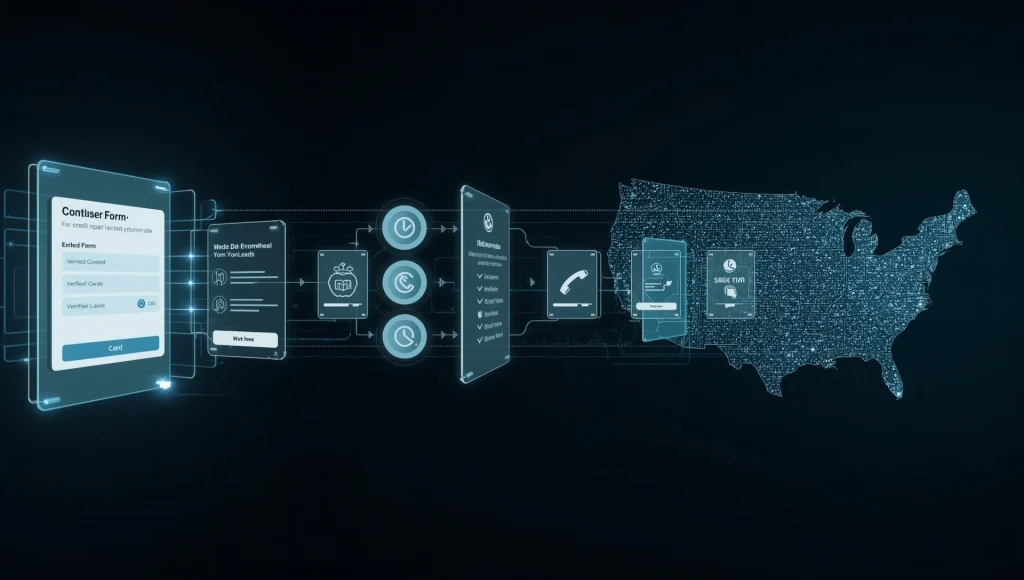
Table of Contents
What Are Credit Repair Leads?
Credit repair leads are prospective consumers who have shown interest in help with credit-report issues, credit improvement, inaccurate reporting, debt-related credit challenges, or readiness for a future mortgage, auto loan, rental application, or other financing goal that may matter to a buyer.
For a B2B buyer, a lead is not automatically a client. It is a starting point for a buyer who needs a real conversation.
A typical credit repair lead may include:
- Full name
- Phone number
- Email address
- State, city, or ZIP code
- Time and date of inquiry
- Stated reason for seeking help
- Credit-related concerns or goals
- Preferred contact time
- Landing-page source or publisher information
- Consent language and consent record
- Call recording, where applicable and permitted
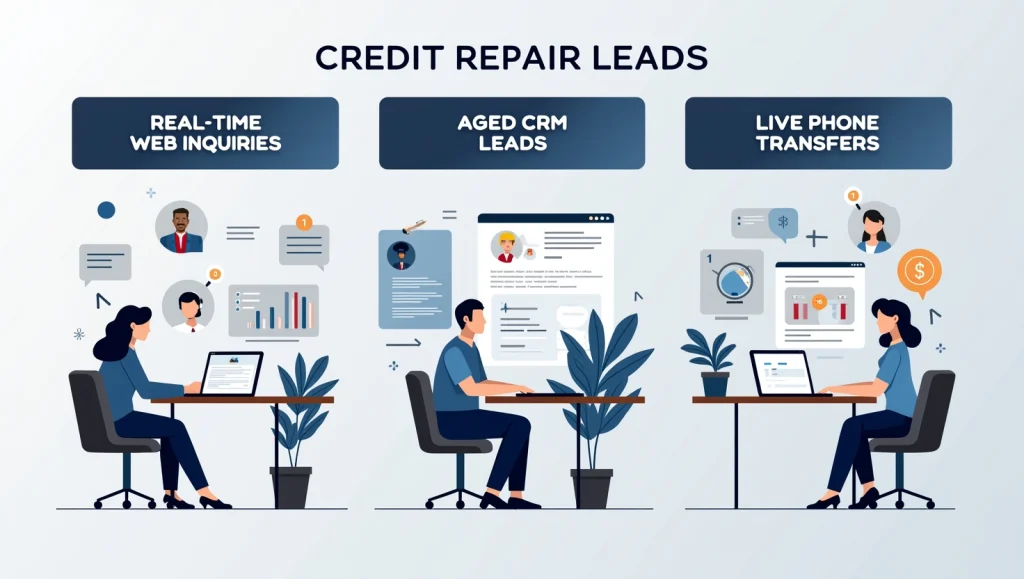
- Lead type, such as exclusive, shared, real-time, aged, or live transfer
The ideal prospect is not simply someone with a low credit score. It is someone who has actively asked for information, understands that credit repair is not magic, and is reachable when your team follows up—so the buyer gets a real chance to convert interest.
That last part sounds obvious. Yet many businesses still judge vendors by cost per lead alone.
10 Ways to Get Better Credit Repair Leads
There is no single magical channel. The strongest businesses usually combine lead sources, track outcomes, and keep the channels that produce enrolled clients—not just pretty dashboards that look good to buyers.
1. Buy exclusive credit repair leads
Exclusive credit repair leads are delivered to one buyer only. In theory, that means you are not sprinting against four other companies who received the same name 30 seconds earlier.
Exclusivity can improve your chance of contact and enrollment, but only if the provider can document how the lead was acquired and whether “exclusive” truly means exclusive. Ask what source criteria define that exclusivity.
Ask directly:
- Is the lead sold to only one company?
- Is the lead ever recycled, resold, or moved into aged inventory?
- What exactly counts as exclusive?
- Does exclusivity apply to the phone number, email, ZIP code, or entire record?
- What happens if another advertiser has already contacted the lead?
2. Use real-time credit repair leads
Real-time credit repair leads are delivered soon after a consumer submits an inquiry. The consumer is actively thinking about the problem right now, which is usually the best moment to call.
Picture someone sitting at a kitchen table at 8:42 p.m., looking at a mortgage denial email and searching for help. By 8:45 p.m., they submit a form. By 8:47 p.m., your business calls. That is a meaningful difference from calling them six days later, when the moment has gone cold.
Real-time delivery is valuable, but it creates a responsibility: your team must be ready.
3. Test credit repair live transfers
Credit repair live transfers, sometimes called warm transfers or live call transfers, connect your team to a consumer who is already on the phone and has expressed interest.
They can be more expensive than form leads. They can also be more valuable because the customer is present, engaged, and ready to speak.
Live transfers work best when:
- You have trained closers available during delivery hours
- Calls are answered immediately
- Your script begins with transparency, not pressure
- Your sales team understands compliant language
- Your CRM logs outcomes fast enough to optimize sources
Do not buy live transfers if your phone team is “usually available.” Inbound intent has a short shelf life. If you send it to voicemail, you have wasted the opportunity.
4. Build content-led credit repair lead generation
Content SEO is one of the more durable ways to generate credit repair clients. It takes time, but it helps you build trust before the first call.
Useful topic clusters include:
- How to read a credit report
- How to dispute inaccurate credit-report information
- Credit improvement before buying a home
- Preparing credit for an auto loan
- Understanding debt-to-income versus credit score
- What consumers can do on their own for free
- How to spot misleading credit repair claims
- What to expect from a compliant credit repair consultation
A good content strategy does not scream, “Fix your credit overnight!” It answers questions calmly, clearly, and honestly.
5. Create compliant referral partnerships
Mortgage brokers, auto dealers, real estate professionals, financial counselors, and lenders often meet consumers whose financing plans are not ready yet. A referral partnership can be useful when it is built around consumer choice, transparency, and appropriate consent.
A lender may meet a borrower who is not currently mortgage-ready. An auto dealer may meet a shopper whose financing terms are unfavorable. A compliant referral relationship can offer consumers educational options rather than a hard sell.
Keep referrals clean:
- Explain the relationship transparently
- Obtain consumer permission before sharing information
- Avoid promises about results or approval
- Use clear referral tracking
- Review compensation structures with legal counsel
- Give consumers room to decide, not a corner to stand in
6. Use educational video and social content
Short educational videos can create demand without relying on “miracle” messaging. Topics such as “Three things to check before disputing a credit-report error” or “What a lender looks at besides score” can attract more informed prospects.
The win is not getting a million views from people who enjoy financial panic as entertainment. The win is earning trust from a smaller group of people who need help and want to speak with a credible professional.
7. Run first-party opt-in funnels
A first-party lead funnel means your organization—or a transparent agency working for it—collects the inquiry directly through a clear landing page.
A strong opt-in funnel includes:
- A plain-language explanation of what the consumer is requesting
- Clear consent language
- Privacy-policy access
- A description of how calls or texts may occur
- A realistic, non-guaranteed offer
- Qualification questions that improve routing
- A visible way to contact your business
First-party acquisition is usually easier to audit than opaque list buying. It also lets you improve the form, message, follow-up timing, and conversion path based on real performance.
8. Buy aged credit repair leads strategically
Aged credit repair leads are older inquiries. They may be 30 days old, several months old, or much older depending on the seller and the source criteria used to classify them.
They are usually cheaper than real-time leads. That does not mean they are bad. It means they need a different operating model.
Aged leads may work for businesses with:
- Persistent outbound teams
- A compliant calling and texting workflow
- Strong CRM sequences
- Accurate source and consent documentation
- A clear re-engagement message
- A lower acquisition-cost target
Do not call an old inquiry and pretend it happened five minutes ago. Be honest: explain who you are, why you are contacting them, and confirm whether they still want information.
9. Build local landing pages
If you serve specific states or regions, localized content can make your offer more relevant. For example:
- Credit repair leads in Texas
- Credit repair leads in Florida
- Credit repair leads in California
- Credit repair leads for mortgage brokers in Georgia
- Credit repair marketing for agencies in Illinois
Avoid cloning the same page 50 times by pasting a different state name into the copy. Add useful local information, state-specific considerations where appropriate, service details, testimonials you are authorized to use, and clear qualification criteria.
10. Make follow-up your unfair advantage
Most lead vendors are not your real competition.
Slow follow-up is.
A business that calls promptly, texts transparently where permitted, documents outcomes, and schedules consultations well can often outperform a business that buys “better” leads but responds 18 hours later.
Exclusive vs. Shared Credit Repair Leads
Not all leads are sold the same way. Before buying, understand the lead model—not just the sales pitch.
| Lead type | What it means | Main advantage | Main risk | Best fit |
| Exclusive credit repair leads | Sold to one buyer | Less direct competition | Higher cost; vendor claims must be verified | Firms with fast follow-up and healthy margins |
| Shared credit repair leads | Sold to multiple buyers | Lower initial cost | Consumers may receive several calls fast | Teams that can call immediately and differentiate clearly |
| Real-time credit repair leads | Delivered shortly after inquiry | Strong current intent | Requires rapid response | Businesses with live sales coverage |
| Aged credit repair leads | Older consumer inquiries | Lower cost and scalable volume | Lower contact rate; consent history needs review | Call centers and nurture-focused teams |
| Live transfers | Consumer is connected by phone in real time | Immediate engagement | Expensive; missed calls waste budget | Sales teams ready to answer instantly |
| Pay-per-call leads | You pay for qualifying calls | Better conversation-level intent | Qualification rules can vary | Performance marketers and call-driven businesses |
There is no universal winner.
A small credit repair organization with one closer may do better with fewer exclusive, real-time leads. A call center with a dialer, dedicated QA team, and structured sequences may make aged credit repair leads work profitably. A mortgage-centered business may prefer referral partnerships and credit-readiness consultations. Match the lead model to the buyer’s operating capacity.
The best model produces ethical, qualified, retained clients at a sustainable cost.

Real-Time, Aged, and Live-Transfer Credit Repair Leads Compared
Here is the practical version.
Real-time leads
These are fresh inquiries. The consumer recently submitted a form, requested information, or otherwise indicated current interest.
Best practice: Make the first attempt within minutes, not days.
Aged leads
These are older records from consumers who expressed interest in the past.
Best practice: Reintroduce yourself honestly, verify continued interest, and confirm that the consumer is willing to receive information before moving into a sales conversation.
Live transfers
These are live phone conversations transferred to your team after some level of screening.
Best practice: Answer immediately. Use a calm opening. Confirm the person’s reason for calling. Never assume that “transferred” means “ready to enroll.”
How Much Do Credit Repair Leads Cost?
Credit repair lead cost varies widely. A price quote without details is not useful. You need to know what you are paying for and what happens after delivery.
Pricing can change based on:
- Exclusivity
- Lead age
- State or ZIP code targeting
- Consumer qualification questions
- Phone verification
- Whether the lead is a form, call, or transfer
- Monthly volume
- Delivery schedule
- Source transparency
- Refund or replacement policy
- Whether the lead is shared or exclusive
The right question is not:
“What is the cheapest credit repair lead?”
The better question is:
“What is my cost per enrolled client after contact, qualification, appointment, enrollment, cancellations, and retention?”
Be careful with revenue assumptions in credit repair. Because of the regulatory structure around fees and service performance, you should measure actual collected revenue, cancellation behavior, service cost, and legal compliance—not fantasy revenue from an optimistic spreadsheet.
How to Verify Consent and Lead Quality
When a provider says its leads are “TCPA-compliant,” treat that as a claim to investigate, not a magic shield.
Your business remains responsible for how it contacts consumers.
Ask the provider for the following in writing:
- A complete copy of the lead form.
- The exact consent language displayed to the consumer.
- The date and time of submission.
- The landing-page URL or traffic source.
- IP, device, event, or session information where relevant and lawfully collected.
- Lead source and publisher identity.
- Call recording or lead event record for inbound calls, where applicable.
- Whether the lead was shared, exclusive, recycled, or resold.
- A description of filters used to qualify the lead.
- The vendor’s replacement and refund policy.
- Documentation of how do-not-call and consent issues are handled.
- The provider’s process for responding to consumer complaints.
A qualified credit repair lead should generally include more than a name and a phone number. At minimum, you want clear intent, reliable contact details, location information, consent evidence, source transparency, and enough context to route the lead appropriately.

Credit Repair Lead Generation Without Google Ads
For credit repair, Google Ads is not a viable acquisition channel. Google’s financial-products policy says ads for credit repair services are not allowed, and the restriction applies to direct advertisers, lead generators, and businesses connecting consumers with third-party credit repair services.
That means “Let’s just run Google Search ads” is not a strategy. It is a fast way to have a very short meeting with a policy team.
Instead, consider a diversified acquisition plan:
| Channel | Best use | Strength | Watch-out |
| SEO content | Long-term inbound demand | Trust-building and compounding traffic | Requires patience and quality content |
| Local SEO | Local service businesses | Strong intent from nearby searchers | Needs accurate business information and reviews |
| Referral partnerships | Mortgage, auto, real estate, lending ecosystems | Warm introductions | Must be transparent and consent-based |
| Educational video | Brand awareness and trust | Human, memorable, reusable | Needs consistent publishing |
| Email nurture | Opted-in prospects | Builds trust over time | Must honor unsubscribe and compliance rules |
| Direct outreach | Re-engaging permitted records | Can scale with a trained team | Requires strict consent and DNC controls |
| Partner networks | Specialized lead supply | Faster testing | Vendor due diligence is essential |
| Organic social | Educational discovery | Helps create familiarity | Avoid misleading claims and overpromises |
The goal is not to replace Google Ads with one shiny new toy. The goal is to build a marketing mix you can explain calmly to a regulator, client, partner, and future version of yourself.
Best Credit Repair Lead Providers to Compare
Below are examples of providers and platforms that publicly market credit repair-related lead solutions. This is not a ranking or endorsement. Provider offerings, pricing, availability, exclusivity, geography, lead sources, and compliance practices can change. Verify every claim before you buy.
| Service | Publicly described model | Potential best fit |
| LeadsHunt | U.S.-focused credit repair leads positioned as verified, exclusive, and locally targeted; its page notes a minimum volume of 50 leads per month | Firms seeking recurring geographically targeted lead flow |
| Lead Planet | Real-time online inquiries from first-party consumer sites and media campaigns | Mortgage-focused businesses and credit-restoration companies |
| Klover Data | Credit repair prospect data for responsive, real-time, cold-call, and mailing-list use cases | Outbound teams and direct-mail programs |
| CoolCredit Partner Network | Partner-network opportunities with stated consumer concerns and credit-report context | Businesses seeking enriched prospect context |
| BrokerCalls | Inbound calls, warm transfers, consent proof, qualification routing, and source optimization | Call-driven teams able to answer immediately |
For example, LeadsHunt publicly positions its service around U.S.-only, locally targeted credit repair leads and notes a 50-lead monthly minimum on its published page. BrokerCalls emphasizes inbound calls, warm transfers, consent proof, and optimizing toward outcomes rather than simply buying cheap inquiries.
Before you buy, run a controlled test. Do not sign a large contract based on a sales call, a glossy landing page, or a promise that every lead is “high intent.” Test a small batch, track every outcome, listen to calls, inspect consent records, and compare vendors using the same measurement rules.
The Follow-Up Playbook for New Leads
The first few minutes after a lead arrives are not the time for a Shakespeare monologue. They are the time for calm, clear, helpful contact.
A simple follow-up flow
- Call quickly. If the consumer just requested help, reach out while it’s still fresh.
- Identify your business. Say who you are and why you are calling.
- Confirm interest. Ask whether they recently requested information about credit-report or credit-improvement services.
- Listen before pitching. Learn the goal: home purchase, auto financing, rental application, rebuilding after hardship, or correcting possible inaccuracies.
- Set expectations. Explain that results depend on the facts, the credit file, the consumer’s actions, and the nature of any disputed information.
- Offer a next step. A consultation, document review, or educational call may be more appropriate than a hard close.
- Log everything. Track contact attempt, answer status, call duration, disposition, qualification, appointment status, and enrollment outcome.
- Nurture responsibly. Use permission-based reminders and content. Stop when the consumer opts out or asks not to be contacted.
Example opening script
“Hi, this is Jordan from [Business Name]. You recently requested information about credit-report or credit-improvement help. Is now still a good time for a quick conversation about what you were looking for?”
Simple. Human. No fireworks. No fake urgency. No “Congratulations, you’ve been pre-approved for a better life.”
Credit Repair Lead Compliance: What You Cannot Ignore
Credit repair is a highly regulated category. Marketing language, telemarketing practices, consumer consent, disclosure obligations, and fee timing are not side notes. They are part of the business model.
Under the Credit Repair Organizations Act, a credit repair organization cannot charge or accept payment for promised services before fully performing them. The FTC’s Telemarketing Sales Rule also imposes important restrictions for credit repair sold through telemarketing.
Avoid lead-generation claims such as:
- “Guaranteed 100-point score increase”
- “We remove all negative items”
- “Erase bad credit overnight”
- “Get a brand-new credit identity”
- “Guaranteed mortgage approval”
- “We have a secret relationship with the credit bureaus”
A better message is honest and still useful:
“Learn about your credit-report options, review potential inaccuracies, and speak with a professional about steps that may support your financial goals.”
It may not sound as flashy as a late-night infomercial. Good. You are building a business, not auditioning for one.
Frequently Asked Questions
1. What are credit repair leads?
Credit repair leads are consumers who have requested information or shown interest in help with credit-report problems, credit improvement, or related financial-readiness goals. They may arrive as web forms, inbound calls, live transfers, referrals, or older inquiry records from identifiable sources.
2. How do credit repair leads work?
A consumer submits an inquiry, calls a number, responds to content, or is referred through a partner. The lead is then delivered to a credit repair business, agency, lender, affiliate, or call center for follow-up. Lead quality depends on intent, recency, contact accuracy, consent, source transparency, and your team’s response speed. Ask for source details so you can verify what qualifies as the lead’s origin.
3. Where can I buy exclusive credit repair leads in the USA?
Businesses comparing exclusive or real-time lead programs should ask how each option fits their buyer goals. Request the original consent language, lead-source information, timestamp, exclusivity definition, geographic availability, and replacement terms in writing.
4. Are credit repair leads exclusive or shared with multiple companies?
They can be either. Exclusive credit repair leads are sold to one buyer, while shared leads may be sold to several businesses. Never assume exclusivity; ask the provider exactly how it defines, monitors, and enforces it.
5. How much do credit repair leads cost?
Costs vary based on lead age, exclusivity, geographic filters, phone verification, qualification criteria, delivery method, and volume. Compare cost per enrolled and retained client so you can judge value for your buyer goals, not cost per raw lead alone.
6. What is the difference between real-time, aged, and live-transfer credit repair leads?
Real-time leads are recent inquiries. Aged leads are older records that require re-engagement. Live transfers connect your team directly with an interested consumer already on the phone. Live transfers can have strong immediate intent, but they require trained staff to answer quickly.
7. Are credit repair leads TCPA compliant?
A provider’s claim that a lead is “TCPA compliant” is not enough by itself. Ask for evidence of consent, including the form, language, timestamp, source, and records related to the consumer’s opt-in. Maintain your own policies for calling, texting, do-not-call screening, opt-outs, and recordkeeping. Verify the source before relying on the compliance claim.
8. How can I verify that a credit repair lead permitted contact?
Request a full consent record, including the exact consent language, the web page or publisher, time and date of opt-in, lead-source data, and related call or event records where applicable. Have counsel review your workflow, especially for calls and texts. Confirm the source details match the lead record.
9. What information should a qualified credit repair lead include?
At a minimum: name, reliable contact information, location, inquiry timestamp, stated reason for interest, source information, and documented permission to be contacted. Better leads may include credit-related goals, preferred contact time, language preference, and qualification answers.
10. What is a good conversion rate for credit repair leads?
No single universal benchmark exists because lead sources, prices, sales skill, compliance screening, and business models vary widely. Track each stage that matters to your team: contact rate, qualified rate, appointment rate, show rate, enrollment rate, cancellation rate, retained-client rate, and collected revenue.
11. How quickly should a credit repair business follow up with a new lead?
As quickly as operationally possible. For real-time inquiries, the best approach is to have a trained person call within minutes. Fast follow-up matters because consumer interest tends to decline over time.
12. Can I use Google Ads to generate credit repair leads?
No. Google’s policy states that ads for credit repair services are not allowed, and it applies to direct providers, lead generators, and businesses connecting consumers to third-party credit repair services.
13. What are the best alternatives to Google Ads for credit repair lead generation?
Consider SEO, local search visibility, educational content, referral partnerships, opt-in lead funnels, video, email nurture, partner networks, and compliant outbound follow-up. Choose channels that fit your buyer strategy instead of relying on a single channel.
14. Can credit repair companies charge clients upfront fees?
Generally, credit repair organizations cannot collect payment before they have fully performed the services they promised under CROA. Telemarketing-related sales can involve additional restrictions under the TSR. Obtain legal advice tailored to your service model and state requirements.
15. How can mortgage brokers, auto dealers, and lenders legally refer credit-repair prospects?
Use transparent relationships, secure consumer permission before sharing data, avoid claims of guaranteed results or approval, and have legal counsel review the referral and compensation structure. The referral should help the consumer understand options, not pressure them into a service.
16. What should I ask a credit repair lead provider before purchasing leads?
Ask for consent documentation, source transparency, lead age, exclusivity status, filters, delivery method, replacement policy, DNC and opt-out handling, geographic availability, data fields, call recordings where relevant, and test-volume options. Make the provider identify the source that produced each lead. Focus on the details that affect your buying decision.
17. How can I reduce duplicate, fake, or low-intent credit repair leads?
Use phone and email verification, deduplication rules, source-level reporting, clear qualification questions, CAPTCHA or fraud controls, call recording review, lead caps, and vendor replacement terms. Most importantly, measure quality by outcomes—not vendor adjectives. Review source-level results so weak sources are easier to spot.
18. What CRM is best for managing credit repair leads and follow-up?
The best CRM is one your team actually uses consistently. Look for lead-source tracking, speed-to-lead alerts, call logging, consent-record storage, automated but controlled follow-up, campaign-level reporting, deduplication, appointment tracking, and role-based access. Choose a system that supports your compliance process, not one that forces you to improvise around it.
Final Thoughts
Credit repair lead generation is not about collecting the largest pile of names.
It is about building a reliable pipeline of consumers who gave meaningful permission to be contacted, understand why they are speaking with you, and receive a truthful explanation of what your business can—and cannot—do.
Start small. Test carefully. Measure outcomes. Keep the consent records. Train your team to sound like thoughtful professionals, not overly casual voices. And remember: in a regulated industry, credibility is not merely a brand asset. It is essential.
If you are buying credit repair leads, begin with a limited test campaign, compare sources by cost per retained enrolled client, and make vendor documentation a non-negotiable part of every purchase decision. Choose the source that best fits your buyer goals.
Some content on this website may be created, assisted, edited, or enhanced using artificial intelligence (AI). AI-generated or AI-assisted content is reviewed where appropriate, but it may contain errors, omissions, or outdated information. To help you use it carefully, please verify important information independently before making decisions.
Affiliate & AI Content Disclosure:
Some links on this website may be affiliate links. If you click one and make a purchase, we may earn a commission at no additional cost to you. We only recommend products or services we believe may be useful to our audience.