Your product may have the best design, smartest features, and strongest engineering team in the market.
But one document still shapes how well customers use it: The product manual.
A great product can still feel like a bad purchase when the manual is confusing. If customers cannot set it up, use it safely, troubleshoot basic issues, or understand what the buttons do, your support team becomes the unofficial instruction manual. That is where professional product manual writing services help create a smoother customer experience.
A skilled manual writer takes the raw ingredients—engineering notes, product specs, CAD files, test builds, screenshots, support tickets, and meetings with subject-matter experts—and turns them into instructions that normal people can follow without needing a decoder ring.
For U.S. organizations launching physical products, complex equipment, connected devices, SaaS platforms, or hardware-software hybrids, clear documentation is not a nice extra. It is part of the product experience. In some industries, it is also tied to safety, regulatory obligations, customer confidence, and less expensive support conversations.
This guide explains what product manual writing services do, when to outsource them, what a professional manual should include, and how to choose the right writer or agency for your product and documentation needs.
Think about it this way:
The maker knows how the product works.
Your customers need to know how to use it.
A good technical writer builds the bridge between those two worlds.

Table of Contents
1. What Are Product Manual Writing Services?
Product manual writing services involve researching, planning, writing, editing, formatting, reviewing, and sometimes illustrating documents that explain how a customer should install, operate, maintain, repair, or troubleshoot a product.
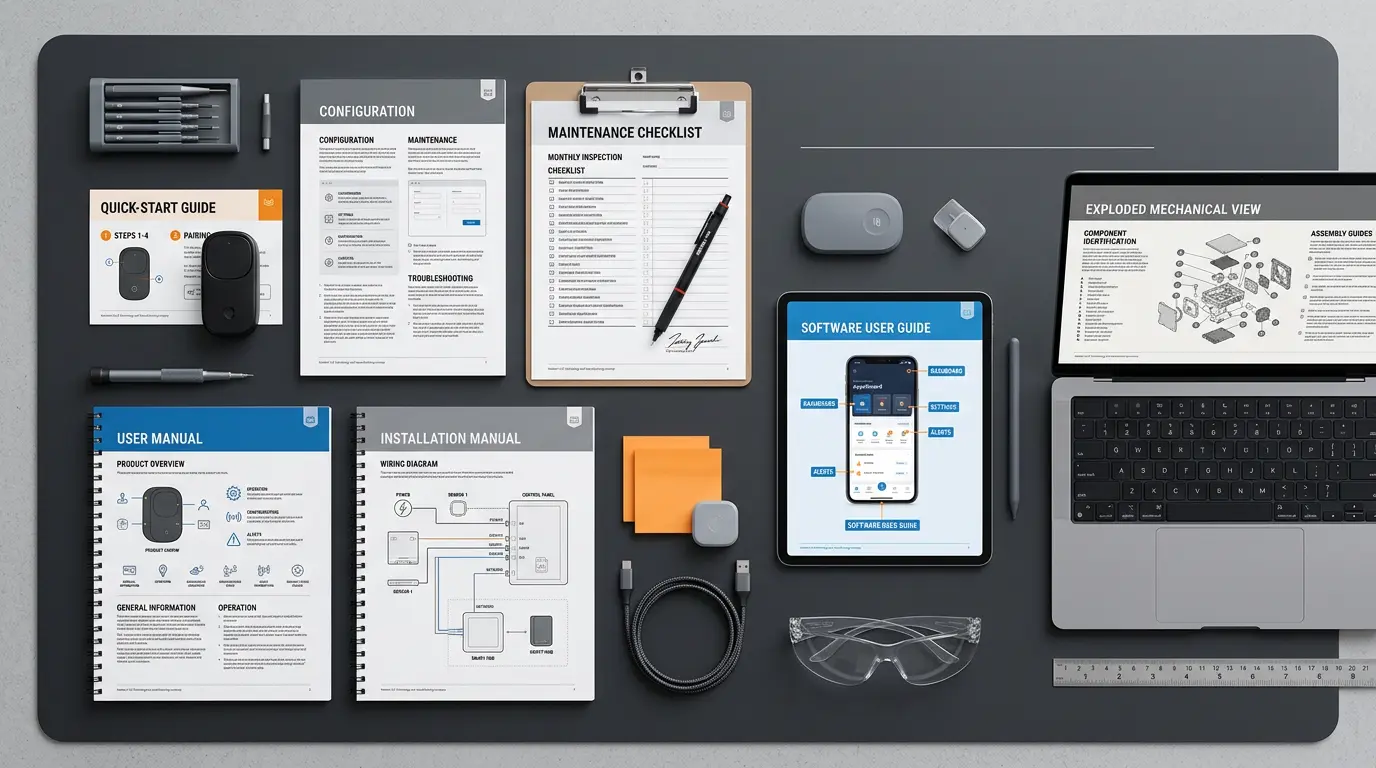
Depending on your product and audience, the final document may be called:
- Product manual
- User manual
- Owner’s manual
- Instruction manual
- Technical manual
- Installation guide
- Quick-start guide
- Operating manual
- Maintenance manual
- Service and repair manual
- Troubleshooting guide
- Safety instruction booklet
- Online help center or knowledge base
The name matters less than the outcome. Your customer, technician, installer, or support team should be able to find the right answer quickly and complete the task correctly. That is the real value product manual writing services should deliver.
Professional providers typically build manuals around real workflows and clear deliverables. They do not just copy engineering material into a Word document and call it done. They gather information from product teams, organize it around user tasks, validate details with experts, and deliver files ready for print, PDF, web, or in-product use. When comparing providers, ask whether they follow a similar process and can adapt it to your product, timeline, and review needs.
What is usually included?
| Service area | What it covers | Why it matters |
| Product discovery | Specs, product demos, source files, interviews, support tickets | Helps the writer understand the actual product |
| Content planning | Audience analysis, table of contents, task mapping | Keeps the manual logical rather than chaotic |
| Technical writing | Setup, operation, maintenance, safety, troubleshooting | Gives users direct, useful instructions |
| Editing and QA | Accuracy checks, consistency, grammar, usability review | Prevents confusing or contradictory steps |
| Visual support | Screenshots, diagrams, callouts, photos, illustrations | Makes complicated actions easier to understand |
| Formatting and design | Print layout, PDF formatting, HTML, CMS-ready content | Makes the manual easy to publish and maintain |
| Documentation updates | Version control, revision support, release updates | Keeps the content useful after launch |
A good manual is not a product brochure wearing glasses. It is a practical tool that helps someone get from “I just opened the box” to “It works.” Strong product manual writing services make that outcome easier to achieve. With that in mind, here is why many teams choose professional writers instead of handling manuals in-house.
2. Why Hire Professional Product Manual Writers?
You can write a basic product guide in-house. Many startups do. But there is a difference between a document written by someone who knows the product inside out and one written for someone who knows nothing about it. Professional product manual writing services help close that gap.
That gap is where customer frustration lives.
Your engineers may understand the product perfectly technically. The product manager writes some sections. The marketing team changes the wording.
Three weeks later, everyone has a 60-page document that nobody wants to read.
Your customers do not either. A professional technical writer for product manuals acts as the translator between those two worlds. That is why professional product manual writers help deliver clearer, more usable documentation.
The real benefits of outsourcing
You get clear, task-based instructions.
Professional writers organize content around what users need to do: unpack, connect, install, configure, operate, clean, update, maintain, or fix. That structure is much easier to follow than a wall of product features.
Your technical experts stay focused.
Engineers, developers, product managers, and technicians provide crucial input. But asking them to write, edit, format, revise, and maintain a 70-page manual can slow down the rest of the business.
You reduce avoidable support requests.
Clear setup steps, honest troubleshooting, labeled visuals, and searchable documentation can prevent many “How do I…?” tickets from reaching your support queue. Product documentation providers often frame clear manuals as a way to improve usability and reduce errors, making product manual writing services a practical investment.
You create a more polished customer experience.
A beautiful product with a sloppy manual feels unfinished. A clear, attractive, well-structured guide signals that your organization thought about the customer after the sale—not just before checkout. Product manual writing services help protect that impression.
You can support safety and compliance needs.
For machinery, industrial products, medical devices, electronics, and regulated products, a manual may need safety content, warnings, instructions for use, and documentation aligned with applicable standards or markets. Specialist agencies serving regulated manufacturers often provide compliance documentation, safety instructions, maintenance documentation, and structured authoring as part of their services, helping support both safety and value.
A quick example
Imagine you sell a premium smart irrigation controller.
An internal draft might say:
“Connect the unit to the irrigation system and configure schedules in the app.”
A professional instruction manual writer might turn that into:
“Before connecting the controller, switch off power at the circuit breaker. Connect each zone wire to the matching numbered terminal. Restore power, then open the mobile app and select Add Controller. Follow the on-screen prompts to connect the device to Wi‑Fi.”
Same product. Very different customer experience. That difference is exactly where professional product manual writing services add value. Next, let’s look at the kinds of manuals these services create so you can match the right option to your product.
3. Types of Manuals a Writing Service Can Create
The best product documentation services do not treat every product as if it needs the same document. A quick-start guide for a Bluetooth speaker has little in common with a maintenance manual for industrial equipment or a software administrator guide, so the right service should match the document to the customer’s task and buying need.
Here are the most common deliverables.
| Manual type | Best for | Typical content |
| User manual | Consumer products, apps, electronics, SaaS | Features, setup, operation, FAQs, troubleshooting |
| Instruction manual | Consumer products, kits, appliances | Assembly, use, care, warnings, parts list |
| Quick-start guide | New products, onboarding, low-friction setup | Essential first steps, QR codes, basic controls |
| Installation manual | Hardware, equipment, software deployments | Site requirements, tools, wiring, configuration |
| Technical manual | Equipment, systems, B2B products | Technical specs, operation, maintenance, references |
| Service manual | Repair teams, technicians, dealers | Diagnostics, repairs, parts, disassembly procedures |
| Maintenance manual | Machinery, facilities, industrial products | Scheduled maintenance, cleaning, inspections |
| Troubleshooting guide | Any product with common user issues | Symptoms, likely causes, corrective actions |
| Software user guide | SaaS, apps, enterprise platforms | Workflows, screens, permissions, reporting, integrations |
| SOP or work instruction | Manufacturing and operations teams | Repeatable internal processes, quality steps, safety tasks |
Many technical writing agencies offer a broader mix of manuals, along with product and software documentation, knowledge base content, SOPs, and work instructions. When comparing providers, confirm which document types they handle, whether they align with your product and audience, and how their experience matches your documentation needs.
4. When Should You Outsource Product Manual Writing?
The short answer: outsource before your manual becomes the launch-day panic project. Product manual writing services help you avoid last-minute scrambling and keep the documentation aligned with the product. Here are the situations where outsourcing makes the most sense for buyers, and what to compare before you choose.
You should strongly consider technical documentation outsourcing when:
- You are launching a new physical, hardware, industrial, or software product.
- Your existing product manual is outdated or hard to understand.
- Engineers are writing documentation in their spare time.
- Support teams keep answering the same setup questions.
- Your product has safety, installation, repair, or maintenance requirements.
- You need diagrams, screenshots, layout, or print-ready files.
- You are expanding into new markets and require translation or localization.
- You need documentation in multiple formats, such as PDF, printed booklet, online help center, and in-app guidance.
- You have a product update cycle that demands ongoing documentation maintenance.
A manual can also be created while a product is still in development. Writers can work from prototypes, product requirements, CAD drawings, test builds, UI designs, developer documentation, and interviews with engineers. The key is building revision time into the project, because products have a charming habit of changing right after the manual draft is approved. If you are comparing providers, ask how they handle draft reviews, revision cycles, and late-stage product changes before you commit. With that in mind, here’s what a professional product manual should include.
5. What Should a Professional Product Manual Include?
There is no universal template. A toaster manual and a medical device manual should not look like cousins. Still, most professional manuals share a strong backbone.
The 10 essential sections
1 – Cover page and product identification
Include the product name, model number, version, publication date, and brand details.
2 – Table of contents
This sounds obvious, but it becomes essential once the manual grows beyond a few pages.
3 – Safety information
Include warnings, cautions, symbols, protective measures, and proper-use boundaries where applicable.
4 – What is in the box
The box includes parts, accessories, cables, tools, and optional components.
5 – Product overview
Label controls, ports, buttons, connectors, screens, and key components.
6 – Set up or installation instructions.
Give the user a clean path from unboxing to first successful use.
7 – Operating instructions
Explain core tasks in the order users are likely to perform them.
8 – Maintenance and care
Cover cleaning, storage, inspections, firmware updates, and service intervals where needed.
9 – Troubleshooting
Use plain symptoms and direct fixes. “Device not connecting?” is better than “Network connectivity anomaly.”
10 – Technical specifications and support details
Include dimensions, power requirements, compatibility, warranty information, support channels, and disposal guidance if relevant.
The strongest manuals use clear language, logical organization, consistent terms, visuals, safety information, and user testing to catch confusing steps before customers do.
6. Product Manual Writing Services vs In-House Writing
| In-House Writing | Outsourced Manual Writing |
| Uses internal employees | Uses specialized writers |
| Engineers spend time documenting | Engineers focus on development |
| Documentation skills may vary | Professional writing process |
| Limited external perspective | User-focused approach |
For companies launching multiple products, outsourcing can create a repeatable documentation system.
7. What Types of Products Majorly Need Manual Writing Services?
Almost every product category can benefit from professional documentation.
Consumer Electronics
Examples:
- Smart home devices
- Wearables
- Appliances
- Audio equipment
- Electronic accessories
Industrial Equipment
Examples:
- Manufacturing machines
- Tools
- Automation systems
- Production equipment
Software Products
Examples:
- SaaS platforms
- Mobile applications
- Enterprise software
- APIs
Medical and Healthcare Products
Examples:
- Medical devices
- Laboratory equipment
- Healthcare technology
Automotive and Engineering Products
Examples:
- Vehicle components
- Embedded systems
- Technical equipment
A strong product manual writing company adapts documentation style based on the user, product complexity, and industry requirements.
8. How the Product Manual Writing Process Works
A professional process should feel organized, collaborative, and a little less dramatic than a last-minute Google Docs battle.
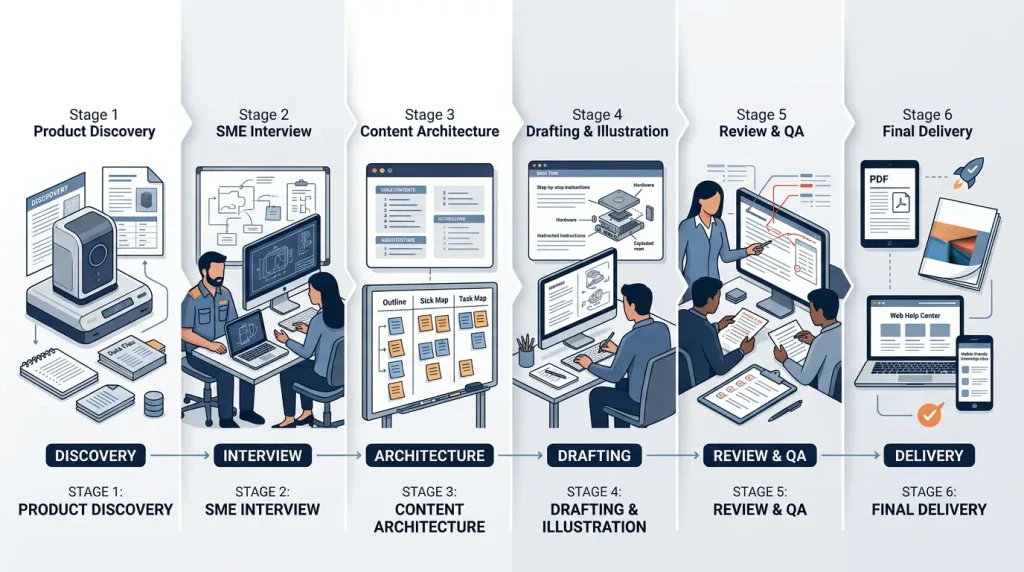
Step 1: Discovery and scoping
The writer learns what you are making, who will use it, where it will be used, and what the final documentation must accomplish.
You may be asked to provide:
- Product specifications and engineering documents
- Product access, prototype, demo, or test account
- Existing manuals and documentation
- Photos, videos, drawings, or CAD files
- App screens, UI mockups, or screenshots
- Support tickets and common customer questions
- Brand guidelines and terminology lists
- Safety requirements and applicable regulations
- Access to engineers, technicians, developers, or product managers
Step 2: Information gathering
The writer interviews subject-matter experts and studies the product. This is where the magic happens—well, the organized kind of magic involving spreadsheets, annotated screenshots, and a suspicious number of open browser tabs.
Step 3: Documentation architecture
Before drafting every paragraph, the writer creates a content plan. This may include:
- Audience profiles
- Manual outline
- Task map
- Terminology guide
- Style and formatting rules
- Visual requirements
- Review schedule
- Delivery format plan
Step 4: Drafting and visual development
The writer creates the instructions, while a designer or illustrator may prepare screenshots, photos, flowcharts, exploded diagrams, labeled callouts, or safety graphics.
Step 5: SME review and quality assurance
Your engineers and product experts review for technical accuracy. The documentation team checks usability, readability, consistency, grammar, layout, hyperlinks, figure references, and formatting.
Step 6: Final delivery and future updates
You should receive publication-ready files in the formats you need, such as:
- Editable source files
- Print-ready PDF
- Web-ready HTML
- Markdown
- CMS-ready knowledge-base articles
- In-app documentation copy
- Translation-ready source content
Professional technical writing workflows commonly rely on discovery, planning, content development with subject-matter expert input, review, and publication-ready delivery.
9. How Much Do Product Manual Writing Services Cost?
There is no one-size-fits-all price for product manual writing services. Anyone who gives you a precise quote before understanding the product, source material, review process, required visuals, and compliance needs is probably pricing a mystery box.
Costs usually depend on:
| Cost factor | Why it changes the scope |
| Product complexity | More advanced products need deeper research and more validation |
| Manual length | A two-page quick-start guide is not a 150-page service manual |
| Product maturity | In-development products often require more revisions |
| Available source material | Strong specs and existing documentation reduce research time |
| SME access | Delayed interviews can extend the timeline |
| Visual requirements | Custom diagrams, technical illustrations, and screenshots add work |
| Compliance needs | Regulated industries require specialized expertise and review |
| Number of formats | Print, PDF, HTML, in-app help, and localization create additional deliverables |
| Revision cycles | More stakeholders usually mean more review time |
| Ongoing updates | A live product needs a documentation maintenance plan |
The best approach is to request a scoped proposal. Share your product type, audience, source material, target length, expected deliverables, deadline, and examples of manuals you like. A good provider will ask smart questions before quoting.
10. How to Choose the Right Product Manual Writing Company
Do not choose a provider based only on a pretty website or a low per-word rate. Product documentation is not generic blog content. It needs structure, technical accuracy, user empathy, and a process that works with your team.
Use this vendor-selection checklist.
- Ask for samples similar to your product type or industry.
- Confirm whether the team has experience with hardware, software, manufacturing, regulated products, or technical equipment relevant to your project.
- Ask how they collect information from engineers and subject-matter experts.
- Check whether they can create or coordinate diagrams, screenshots, illustrations, and layouts.
- Clarify how technical accuracy is reviewed and approved.
- Ask which authoring, publishing, and file formats they support.
- Confirm how they handle version control and updates after launch.
- Review security practices if you will share confidential designs or unreleased product information.
- Get clarity on revision rounds, timelines, ownership, and editable source files.
- Ask whether they can support translation and localization if you sell internationally.
U.S.-focused providers worth evaluating
The following options are relevant based on their stated manual-writing and technical-documentation services. This is not an absolute ranking; the right choice depends on your industry, product complexity, required deliverables, budget, and compliance needs.
| Provider | Best fit | Why consider them |
| ProEdit | Broad product, equipment, software, and technical documentation | Offers user manuals, product manuals, technical manuals, installation guides, maintenance manuals, troubleshooting guides, SOPs, and knowledge-base content. |
| Essential Data Corporation (EDC) | Flexible writing support for individual projects or larger documentation programs | Markets product, user, instruction, and technical manual services with audience-focused documentation support. |
| INSTRKTIV | Regulated machinery and industrial-product documentation | Focuses on user manuals, safety instructions, maintenance documentation, online help, compliance documentation, and structured authoring. |
| TimelyText | Complex technical manual projects | Provides technical-manual support centered on structured documentation for installing, operating, maintaining, and troubleshooting products and systems. |
| BrightWright | Highly technical engineering, life-science, electronics, and specialist industries | A strong fit when subject-matter depth and precision are more important than generic documentation volume. |
11. Frequently Asked Questions About Product Manual Writing Services
1 – What are product manual writing services?
They are professional services that create or improve manuals explaining how to set up, operate, maintain, troubleshoot, repair, or safely use a product. The service can include research, SME interviews, writing, editing, formatting, visuals, quality assurance, and final publishing files.
2 – What is the difference between a user manual and a product manual?
A product manual is a broad term for documentation that supports a product. A user manual usually focuses on what an end user needs to know to set up and use the product.
For example, a product may have a user manual for customers, an installation guide for installers, and a service manual for technicians.
3 – Can a technical writer create a manual from scratch?
Yes. A skilled writer can work from product specs, prototypes, design files, videos, test environments, support data, engineering documents, and interviews with your experts. The manual should be reviewed as the product evolves.
4 – Can manual writing services include diagrams and illustrations?
Yes. Many providers either create visuals in-house or coordinate them with technical illustrators and designers. Common visuals include annotated screenshots, flowcharts, exploded diagrams, labeled product photos, warning icons, and wiring diagrams.
5 – Can product manuals be written for software, too?
Absolutely. Software user manual writing services can cover onboarding, feature instructions, admin guides, permission settings, configuration, integrations, release notes, troubleshooting, and help-center articles.
6 – How long does it take to create a product manual?
It depends on the scope. A compact, quick-start guide may move quickly if product details are ready. A detailed equipment manual, software guide, service manual, or compliance-sensitive document can take longer because it requires research, technical reviews, visuals, and revision cycles.
7 – Can an existing product manual be improved?
Yes. A product manual editing and proofreading project can involve restructuring content, simplifying language, rewriting procedures, updating outdated screenshots, adding missing warnings, improving troubleshooting guidance, correcting terminology, and redesigning the layout.
8 – What formats can the completed manual be delivered in?
Common options include editable Word files, Google Docs, Adobe InDesign packages, print-ready PDFs, web pages, HTML, Markdown, knowledge-base articles, or CMS-ready content. Decide this early so your documentation can be maintained after launch.
9 – Can writers create manuals for products still in development?
Yes. Technical writers can work with prototypes, engineering documents, CAD files, and expert interviews before final product release.
12. Final Thoughts
A product manual is not just paperwork or a document tucked under foam packaging. It is part of your product experience. It shapes onboarding, safety, customer confidence, support workload, and the quiet moment when someone decides whether your company feels professional. A customer may never meet your engineering team, product manager, or support department. The manual may be the only conversation they have with your brand after purchase.
The best product manual writers do more than explain buttons and features. They anticipate real questions, turn technical complexity into practical action, respect the reader’s time, and give your internal teams a documentation process they can actually maintain.
Professional product manual writing services help companies create documentation that is accurate, easy to understand, and useful when customers need it most.
If your organization is launching a product, updating a difficult manual, expanding a product line, or drowning in repeat support questions, now is a good time to audit your documentation. Gather your specs, identify the customer tasks that cause the most friction, and ask a qualified documentation partner for a scoped review.
Your product may be brilliant. Make sure the manual is visible and useful to people.
Affiliate & AI Content Disclosure:
Some links on this website may be affiliate links. If you click one and make a purchase, we may earn a commission at no additional cost to you. We only recommend products or services we believe may be useful to our audience.
Some content on this website may be created, assisted, edited, or enhanced using artificial intelligence (AI). AI-generated or AI-assisted content is reviewed where appropriate, but it may contain errors, omissions, or outdated information. To help you use it carefully, please verify important information independently before making decisions.