
You’ve seen the RFP drop. The deadline is tight. The stakes are high. And somewhere between Section L instructions and evaluation criteria, you’re wondering: Do we really have to do this alone?
Here’s the truth: professional tender writing isn’t just polished prose. It’s about turning complex requirements into a compliant, compelling narrative that evaluators can’t ignore. Whether you’re chasing federal contracts, state and local government bids, or commercial RFPs, the right proposal support can help you move from compliance to a stronger competitive position.
In the United States, you may hear this service referred to as proposal writing services, bid writing services, or RFP response writing services. The terminology changes, but the goal stays the same: create a clear, compliant, persuasive submission that gives your business the strongest possible opportunity. This section explains common U.S. terms so you can quickly compare services.
In this guide, I’ll walk you through what tender writing services include, how much they cost, when to outsource, and how to choose a partner who understands your industry.

Table of Contents
What Is Professional Tender Writing?
Let’s start with the basics. Professional tender writing is the service of outsourcing the research, strategy, and composition of bid responses—commonly called tenders, proposals, or RFP responses—to experienced specialists. This section defines the service and what it covers.
In the U.S., you’ll hear this referred to as:
- Proposal writing services
- RFP response writing
- Government proposal writing
- Bid writing services
- Government contracts
- Corporate procurement requests
- Public sector tenders
- Construction bids
- Technology contracts
- Healthcare proposals
- Consulting opportunities
- Supplier agreements
Companies usually refer to these documents as:
- RFP responses
- Government proposals
- Bid submissions
- Proposal packages
- RFQ responses
Why the terminology shuffle? “tender” is more common in the UK, Australia, and Commonwealth countries. In America, “proposal” and “RFP” dominate—especially in federal contracting. But make no mistake: the goal is the same. Turn a dense solicitation into a clear, compliant, persuasive submission that checks every box and shows your value
What’s typically included?
- Solicitation analysis and compliance mapping
- Bid/no-go recommendations
- Win strategy and theme development.
- Submission support and deadline management.
- Full proposal drafting (technical, management, past performance, pricing)
- Editing, graphics, and final production
Tender Writing vs. Proposal Writing vs. RFP Writing
Confused by the jargon? You’re not alone. Here’s a quick decoder:
| Term | Common Usage | What It Means |
| Tender Writing | International, public-sector | Preparing responses to formal “tenders” or ITTs (Invitations to Tender) |
| Proposal Writing | U.S. commercial & government | Crafting narratives for RFPs, RFQs, IDIQs, task orders, and unsolicited proposals |
| RFP Writing | Specific to Request for Proposals | Focused on responding to structured RFP documents, often with strict formatting and evaluation criteria |
| Bid Writing | General term (UK & U.S.) | Umbrella phrase for any competitive submission, public or private |
Bottom line: If you’re in the U.S., you’ll get more traction searching for “proposal writing services” or “RFP response writing.” But if you type “tender writing,” good providers will still know what you need.
What Does a Professional Tender Writer Do?
Think of a tender writer as your proposal quarterback. They don’t just write—they orchestrate the work from requirements to submission.
Core responsibilities:
- Decode the RFP: Translate dense requirements into an actionable plan.
- Build a compliance matrix: Map every mandatory requirement to a section in your proposal.
- Develop win themes: Craft the core messages that make your solution stand out.
- Interview SMEs: Extract technical details from your team and turn them into evaluator-friendly language.
- Write and edit: Produce clear, persuasive narratives across all proposal volumes.
- Coordinate reviews: Manage color-team reviews (pink, red, gold) to catch gaps before submission.
- Polish and submit: Ensure formatting, graphics, and final files meet exact solicitation specs.
Real talk: I once watched a seasoned proposal manager turn a 200-page RFP into a one-page compliance checklist in under an hour. That’s the kind of clarity you’re paying for, and it explains why bringing in help can change the outcome.
When Should You Hire a Tender Writing Consultant?
Not every bid needs outside help. But when the stakes rise, calling a pro is a smart move, especially in situations like these:
- High-value or strategic pursuits where the contract could transform your business.
- Complex federal solicitations with strict Section L and M requirements.
- Tight deadlines that outpace your internal capacity.
- First-time government bidders navigating SAM.gov, past performance, and evaluation criteria.
- Repeated losses despite strong technical solutions—your narrative might be the weak link.
- Lack of internal expertise in proposal strategy, compliance, or persuasive writing.
How Much Does Professional Tender Writing Cost?
Ah, the million-dollar question. Pricing varies based on scope, complexity, and provider type. Here’s a realistic breakdown for the U.S. market in 2025–2026:
| Service Type | Typical Cost Range | What’s Included |
| Freelance bid writer (per day) | $400–$800/day | Drafting, editing, light strategy |
| Specialist agency (per day) | $800–$1,200+/day | Full-service support, reviews, graphics |
| Fixed fee per tender (small) | $1,500–$3,000 | Straightforward RFPs, limited volumes |
| Fixed fee per tender (mid-size) | $3,000–$7,000 | Multi-volume proposals, compliance mapping |
| Fixed fee (complex federal) | $7,000–$20,000+ | Full lifecycle, color reviews, pricing support |
| Monthly retainer | $2,000–$6,000/month | Ongoing bid support, multiple submissions |
| Proposal review only | $500–$1,500 | Compliance check, scoring assessment, recommendations |
Factors that push costs up:
- Federal vs. commercial (federal is more complex)
- Number of proposal volumes (technical, management, past performance, cost)
- Need for graphics, desktop publishing, or oral presentation prep.
- Turnaround time (rush jobs cost more)
- Industry specialization (defense, healthcare, IT may command premium rates)
Pro tip: Don’t shop on price alone. A $5,000 proposal that wins a $500,000 contract is a better deal than a $1,500 proposal that gets rejected for non-compliance, so think about value, not just cost.
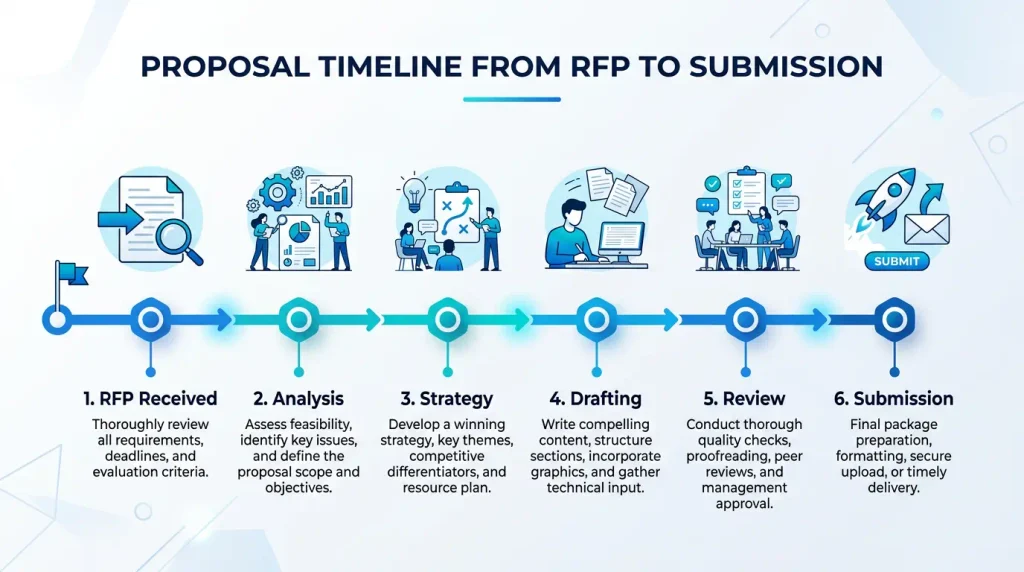
The Tender Writing Process: From RFP to Submission
Here’s how top-tier providers typically structure the workflow:
Step 1: Opportunity Review & Bid/No-Go Decision
Before a single word is written, smart teams ask: Should we even bid? A formal bid/no-go analysis weighs factors like fit, competition, resources, and win probability.
Step 2: Compliance Matrix & Evaluation Criteria Mapping
This is where amateurs get eliminated. A compliance matrix lists every mandatory requirement from the solicitation and maps it to a specific proposal section. Miss one item? You could be disqualified on a technicality alone.
Step 3: Strategy, Win Themes, and Storyboarding
What makes your solution unique? Win themes are the core messages that tie your approach to the evaluator’s priorities. Think of them as your proposal’s North Star.
Step 4: Drafting Technical, Management, and Pricing Volumes
This is the heavy lifting. Professional writers turn your SMEs’ brain dumps into clear, evaluator-friendly narratives. They also coordinate with your pricing team to ensure the cost-volume aligns with your technical approach.
Step 5: Reviews, Editing, Graphics, and Final Submission
Before hitting “submit,” your proposal goes through color-team reviews (pink for strategy, red for compliance, gold for final polish). Graphics and formatting get locked in. Then—deadline met, fingers crossed.
Can Tender Writers Help With Government Contracts?
Absolutely. In fact, government proposal writing is where specialist tender writers shine. Federal, state, and local procurements come with unique rules, and each level calls for a different focus:
- Federal: Strict adherence to FAR, Section L (instructions), and Section M (evaluation criteria). Past performance and staffing plans carry heavy weight.
- State & Local: Often more flexible but still require compliance with specific formatting and submission portals.
- Commercial RFPs: Less regulated but highly competitive—your narrative and differentiation matter most.
Top services for government work:
- The RFP Firm (federal, state, local, commercial)
- GDI Consulting (federal capture and proposal development)
- Winvale (proposal support for IDIQs, GWACs, task orders)
- UA Solutions (full-cycle federal, state, local proposal writing)
- Cavalry Consulting (capture, strategy, and proposal writing)
- Government Contract Inc (compliance matrices, win themes, graphics)
Top U.S. Tender & Proposal Writing Services
Here’s a quick snapshot of reputable providers to benchmark against:
| Provider | Best For | Key Offerings |
| The RFP Firm | Federal, state, local, commercial RFPs | Full proposal writing, templates, consulting |
| GDI Consulting | Federal contractors | Capture management, proposal writing, compliance reviews |
| Winvale | IDIQ, GWACs, task orders | Turnkey proposal development, color reviews, graphics |
| UA Solutions | Federal, state, local proposals | Opportunity ID, writing, reviews, submission |
| Cavalry Consulting | Strategic pursuits | Capture, proposal writing, marketing support |
| Government Contract Inc | Compliance & win strategy | Matrices, narratives, graphics, recruitment |
Note: Always request samples, confirm who will do the work, and review confidentiality terms before signing.
How to Choose the Right Tender Writing Partner
Not all writers are created equal. Here’s my no-BS checklist:
- Industry fit: Have they written proposals in your sector (IT, construction, healthcare, nonprofit)?
- Buyer type experience: Federal is different from commercial. Make sure they’ve played in your sandbox.
- Process transparency: Do they build compliance matrices? Run color reviews? Manage SME interviews?
- Team clarity: Who’s actually writing? A senior strategist or a junior drafter?
- Turnaround & capacity: Can they handle your deadline without burning out?
- Confidentiality: Will they sign an NDA? Who owns the final content?
- References: Ask for anonymized samples or client testimonials.
Red flags:
- Guaranteed win rates (no one can promise that)
- Vague about who’s doing the work
- Unwilling to share process details or samples
- No clear revision or review process
Frequently Asked Questions (FAQs)
1. What is professional tender writing?
It’s the outsourced service of preparing compliant, persuasive bid responses—RFPs, RFQs, ITTs, and government proposals—by experienced specialists.
2. What does a professional tender writer do?
They analyze solicitations, build compliance matrices, develop a winning strategy, draft proposal volumes, coordinate reviews, and manage final submission.
3. What’s the difference between tender writing, bid writing, proposal writing, and RFP writing?
They’re largely interchangeable. “Tender” is more international; “proposal” and “RFP” dominate in the U.S. “Bid” is a general umbrella term.
4. When should a business hire a professional tender writer?
For high-value bids, complex federal solicitations, tight deadlines, first-time government contracting, or when internal capacity is stretched.
5. How much does professional tender writing cost?
Freelancers: $400–$800/day. Agencies: $800–$1,200+/day. Fixed fees: $1,500–$20,000+ depending on complexity. Retainers: $2,000–$6,000/month.
6. Can a tender writer help with government contracts and public-sector bids?
Yes—specialists routinely handle federal, state, local, and commercial RFPs with strict compliance requirements.
7. What documents do I need to provide a tender writing service?
The RFP/solicitation, your company capabilities, past performance records, technical solution details, pricing inputs, and any existing drafts or boilerplate content.
8. Can a tender writer help us find suitable tender or RFP opportunities?
Some providers offer opportunity identification and bid/no-go analysis as part of capture support.
9. How long does it take to write a tender response or RFP proposal?
Anywhere from 3 days for a short RFQ to 4–8 weeks for a complex federal proposal—depending on scope and deadline.
10. Can a professional tender writer improve an existing bid before submission?
Absolutely. Proposal review and editing services can tighten compliance, clarify messaging, and boost scoring potential.
11. What is a compliance matrix, and why is it important in tender writing?
It’s a checklist mapping every mandatory RFP requirement to a proposal section. Missing one item can get you disqualified.
12. How do tender writers address evaluation criteria and scoring requirements?
They align win themes and narratives directly to the evaluator’s scoring rubric, ensuring each criterion is clearly addressed and evidenced.
13. Can a tender writer help with technical proposals, pricing narratives, and past-performance sections?
Yes—full-service providers handle all proposal volumes and coordinate with your SMEs and pricing team
14. Do professional tender writing services guarantee a contract win?
No. Wins depend on fit, price, competition, past performance, and evaluator judgment. Beware of anyone promising guaranteed results.
15. How can I assess whether a tender writing company is qualified for my industry?
Request samples, ask for client references, verify buyer-type experience (federal vs. commercial), and confirm their process includes compliance mapping and reviews.
16. Can a tender writer support federal, state, local, and commercial RFPs?
Top providers cover all of the above, but confirm their specific experience in your target buyer type.
17. What should I look for when choosing a proposal-writing consultant?
Look for industry fit, process transparency, team clarity, turnaround capacity, confidentiality terms, and references.
18. Can AI be used for tender writing, and what still requires human review?
AI can accelerate drafting and research, but human experts are essential for strategy, compliance, SME interviews, and final polish
Ready to Win More Bids? Let’s Talk
If you’re staring down a high-stakes RFP and wondering whether to go it alone or bring in reinforcements, here’s my take: professional tender writing isn’t an expense—it’s an investment in your win rate.
The right partner won’t just write your proposal. They’ll help you think strategically, comply meticulously, and communicate persuasively. And in a game where one missed requirement can cost you the contract, that’s worth every penny.
So, what’s your next move?
- Bookmark this guide for your next bid.
- Share it with your team (because nobody should fly blind on an RFP).
- Or, if you’re ready to explore working with a pro, start by requesting samples and process walkthroughs from a few providers.
Affiliate & AI Content Disclosure:
Some links on this website may be affiliate links. If you click one and make a purchase, we may earn a commission at no additional cost to you. We only recommend products or services we believe may be useful to our audience.
Some content on this website may be created, assisted, edited, or enhanced using artificial intelligence (AI). AI-generated or AI-assisted content is reviewed where appropriate, but it may contain errors, omissions, or outdated information. To help you use it carefully, please verify important information independently before making decisions.